
Summarize this post with AI
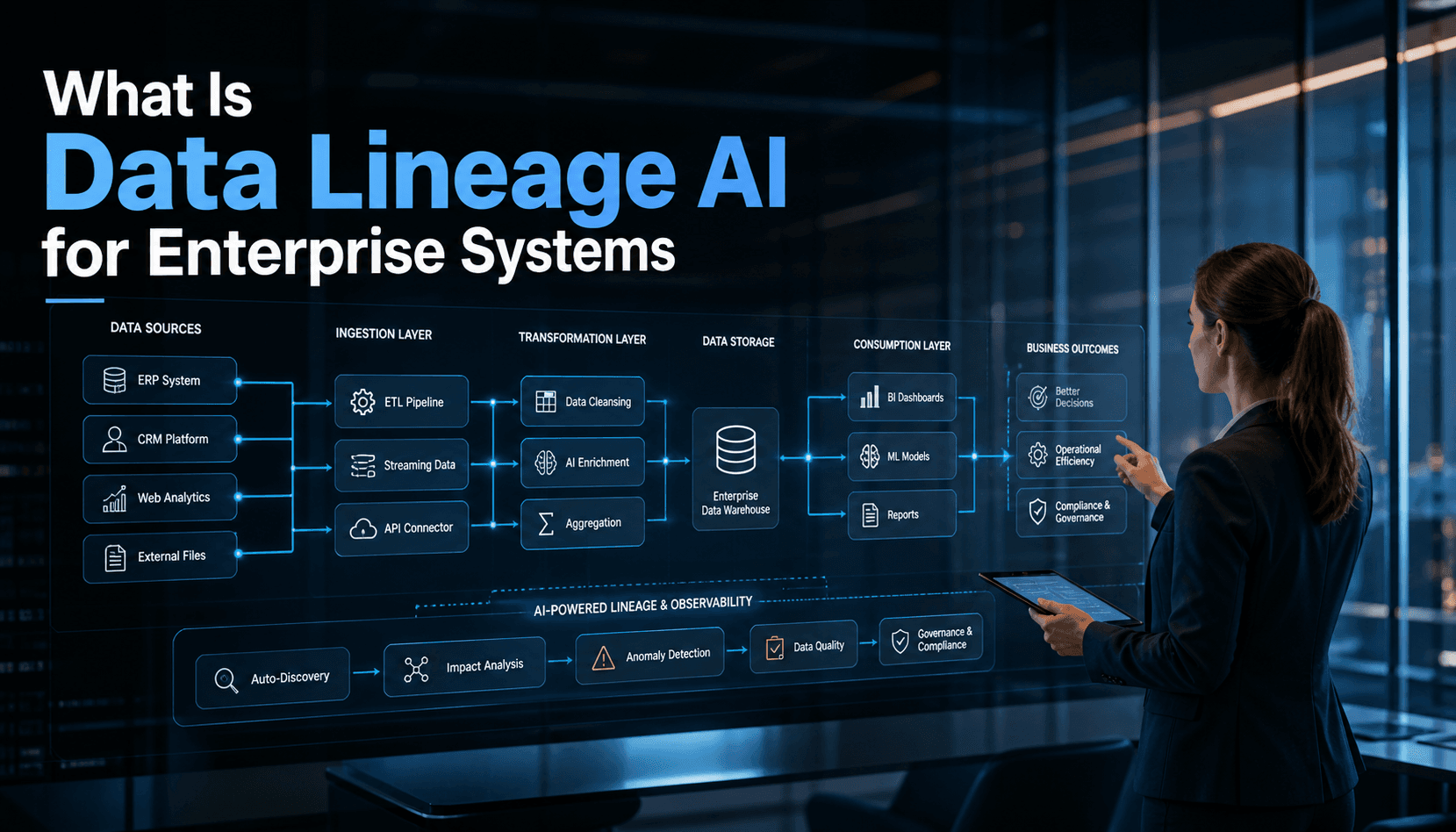
For enterprise leaders asking what is data lineage ai, it refers to the systematic tracking of data as it moves from its origin to AI and ML model consumption. In modern architectures, data lineage in ai provides complete visibility into how data is collected, transformed, and used across pipelines ensuring accuracy, compliance, and trust. With ai data lineage explained, organizations can trace every ingestion point, transformation, and output across their systems. This level of transparency is critical because even minor data inconsistencies can silently degrade model performance. According to the National Institute of Standards and Technology, traceability is a foundational requirement for building trustworthy AI systems. In short, data lineage enables enterprises to audit decisions, debug faster, and maintain regulatory compliance at scale.
Why Data Lineage in AI Matters More Than Ever
As enterprises scale AI, data pipelines become increasingly complex and dynamic. Without data lineage in ai, these pipelines turn into black boxes that are difficult to monitor and control. Organizations investing in AI-ready data engineering gain structured visibility into how data flows across systems, ensuring consistency and reliability.
Without lineage:
Models become opaque and untraceable
Debugging becomes slow and resource-intensive
Compliance risks increase significantly
With lineage:
Data flows are fully auditable
Anomalies are detected faster
Systems remain transparent and explainable
Key Takeaways
End-to-end tracking ensures accountability across the AI lifecycle
Transparent pipelines accelerate debugging and issue resolution
Structured lineage prevents data drift in production
Governance becomes enforceable across enterprise systems
Take the First Step Toward AI Transformation
What This Means in 2026
As AI systems move toward autonomous decision-making, the importance of structured data tracking will only increase. Enterprises must align with a strong AI governance framework 2026 to ensure accountability and compliance. At the same time, seamless system integration through data integration consulting services is essential for maintaining consistent data pipelines. Without this foundation, organizations risk regulatory penalties, inaccurate predictions, and operational instability.
Core Comparison / Explanation
Comparing tracking methodologies and enterprise services across key dimensions:
Focus Area | Core Function | Implementation Scope | Tools / Approach | Impact on Enterprise |
Data Integration Consulting Services | Full lifecycle mapping and governance | End-to-end data ecosystem | High – Ensures end-to-end operational visibility | |
data lineage vs data provenance ai | Mapping movement vs tracking origin | Data origin + flow tracking | Combined lineage + provenance frameworks | Medium – Establishes foundational data clarity |
ml data lineage tracking | Monitoring transformations during training | Model training pipelines | ML observability + modern Data lineage tools | High – Secures algorithmic accuracy |
ai data pipeline lineage | Continuous monitoring in production systems | Real-time production flows | Automated pipeline tracking systems | High – Maintains operational stability |
Practical Use Cases of Data Lineage in AI
Model Debugging
Using data lineage machine learning, teams can quickly identify faulty datasets and resolve training issues efficiently.
Regulatory Auditing
Platforms like the VEDA AI data analytics platform help map complete data flows for audit readiness and compliance reporting.
Data Discovery Before AI Deployment
Before model training, organizations rely on data discovery for AI to identify, classify, and prepare datasets.
Feature Engineering Optimization
Tracking data lineage for ml models ensures that only validated and high-quality inputs influence predictions.
Bias Detection and Mitigation
Historical lineage helps organizations identify biased datasets and improve fairness in AI-driven decisions.
Measure Your AI Model Risk Exposure
Limitations & Risks
Despite its benefits, implementing lineage across enterprise systems presents challenges:
Legacy infrastructure often struggles to integrate with modern Data lineage tools
Large-scale tracking increases storage and computational overhead
Incomplete lineage mapping can create false confidence and hidden risks
Without continuous maintenance, lineage systems can weaken, undermining governance and compliance strategies.
Decision Framework: When to Prioritize Data Lineage
When to Deploy
AI systems influencing financial, legal, or operational decisions
Highly regulated industries requiring audit trails
Complex machine learning pipelines
Organizations often evaluate solutions using AI governance platforms compared frameworks.
When Not to Use
Temporary or isolated test environments
Non-sensitive datasets with manual validation
When to Seek Expert Validation
Enterprises operating in regulated sectors should leverage AI security compliance services to ensure audit readiness and regulatory alignment.
Conclusion
Understanding what is data lineage ai is fundamental to building reliable, scalable, and compliant AI systems. Without visibility into data origins and transformations, enterprises risk deploying inaccurate, biased, and non-compliant models. With strong data lineage in ai, organizations gain transparency, faster debugging capabilities, and regulatory confidence. In today’s AI-driven enterprise landscape, data lineage is not just a technical necessity it is a strategic advantage.
Let’s Build Your AI Strategy Together
About Samta
Samta.ai is a Singapore-headquartered AI Product Engineering & Data Intelligence partner helping enterprises build production-grade AI systems for regulated and data-intensive environments.We help organizations move beyond experimentation by engineering scalable, explainable, and enterprise-ready AI solutions from data foundations and model development to workflow automation and deployment.
Our capabilities combine deep AI expertise, data engineering, and product engineering to deliver measurable business impact across FinTech, BFSI, cybersecurity, regulatory technology, and enterprise operations.
Our enterprise AI products power real-world intelligence systems:
• TATVA : AI-driven data intelligence platform for governed analytics, monitoring, and operational insights
• VEDA : Explainable and audit-ready AI decisioning engine built for compliance-sensitive enterprise workflows
• CORA-Property Management Solutions: : Predictive intelligence platform for real-estate pricing, portfolio optimization, and investment analytics
Backed by ecosystem partnerships with Microsoft, Databricks, Snowflake, and AWS, Samta.ai delivers agile, cost-efficient AI engineering with faster turnaround and enterprise-grade scalability. Trusted by enterprises across FinTech, BFSI, and digital transformation initiatives, Samta.ai embeds AI governance, data privacy, and compliance-by-design principles directly into the AI lifecycle , enabling organizations to scale AI with transparency, accountability, and operational control.
Enterprises leveraging Samta.ai automate 65%+ of repetitive data, analytics, and decision workflows while maintaining governance, explainability, and measurable business outcomes. Samta.ai provides the strategic consulting, AI engineering, and data modernization expertise needed to align enterprise operations with next-generation AI transformation goals.
FAQs
What is data lineage in machine learning?
What is data lineage in machine learning refers to tracking datasets used in training models. It ensures reproducibility, transparency, and faster debugging of model performance issues.
What is data lineage in data governance?
What is data lineage in data governance defines how data moves, transforms, and is accessed across enterprise systems, ensuring accountability and compliance.
What is data lineage analysis?
What is data lineage analysis involves mapping and visualizing the flow of data to optimize performance, detect inefficiencies, and improve system reliability.
How do we secure AI pipelines?
Securing pipelines requires integrating lineage tracking with robust infrastructure. Platforms like enterprise AI solutions samta.ai help organizations build transparent, auditable, and secure AI ecosystem