
Summarize this post with AI
Most property portfolios in Singapore are reporting Scope 1 and Scope 2 emissions using spreadsheets and estimated consumption factors rather than metered actuals, which means their operational carbon monitoring proptech reports are producing figures that will not survive the audit trail requirements arriving under SGX mandatory climate reporting in 2026. The gap between estimated and metered carbon data is not a reporting technicality. It is a financial materiality risk for listed property companies and a procurement barrier for institutional tenants requiring verified ESG data. This guide gives Chief Sustainability Officers, property portfolio managers, and technology leads the evaluation framework for selecting operational carbon monitoring proptech that produces audit ready, metered emissions data at portfolio scale.
Operational Carbon Monitoring Proptech:
Operational carbon monitoring proptech is software and IoT infrastructure that collects real time and interval energy consumption data from building meters, converts it to verified carbon emissions figures using grid emission factors and fuel conversion constants, and produces portfolio level ESG reporting aligned to GHG Protocol, GRESB, and SGX climate disclosure standards. For Singapore commercial real estate portfolios in 2026, the minimum viable proptech integration for carbon monitoring requires: IoT energy metering at the building and tenancy level, automated Scope emissions tracking across Scope 1 (direct combustion), Scope 2 (purchased electricity), and Scope 3 (tenant operations and embodied carbon where applicable), and an audit trail connecting raw meter data to published ESG figures. Vendors that produce carbon figures without meter level data lineage cannot satisfy SGX TCFD disclosure requirements or GRESB third party verification.
What Operational Carbon Monitoring Proptech Actually Covers
Monitoring proptech software for carbon and energy spans a wide capability range. Understanding the difference between basic energy dashboards and production grade ESG reporting infrastructure is the first evaluation task. Energy monitoring and control system platforms at the basic level aggregate utility bill data and apply emission factors to produce estimated carbon totals. These are adequate for voluntary ESG reporting but will not satisfy mandatory disclosure requirements or institutional investor due diligence processes that require metered data lineage.
Production grade operational carbon monitoring covers four distinct capability layers:
IoT energy metering: smart meters, pulse meters, or BMS integration at the building, floor, and tenancy level producing interval data (typically 15 to 30 minute readings) rather than monthly utility bill totals. This is the data foundation without which carbon intensity benchmarking at the tenancy or asset level is not possible.
Scope emissions tracking: automated conversion of metered consumption data to Scope 1, Scope 2, and Scope 3 emissions figures using current grid emission factors (Singapore's Energy Market Authority publishes annual grid emission factors), fuel conversion constants, and refrigerant leak estimation for Scope 1. Market based versus location based Scope 2 accounting must be supported for GHG Protocol compliance.
ESG reporting for real estate: production of portfolio level carbon intensity metrics (kgCO2e per square metre per year), asset level benchmarking against green building certification standards (Green Mark, LEED, BREEAM), GRESB submission ready data exports, and TCFD aligned disclosure narratives with data lineage documentation.
Carbon intensity benchmarking: peer comparison against Singapore Building and Construction Authority benchmarks, GRESB sector averages, and net zero pathway alignment tracking against Science Based Targets initiative (SBTi) reduction trajectories.
Best proptech companies for sustainable real estate portfolio management deliver all four layers in an integrated platform, not as separate tools requiring manual data aggregation between them.
Start Your AI Transformation with a Data-Driven Assessment
Why Proptech Vendor Selection Is More Consequential in 2026
Three regulatory and market developments have raised the stakes:
1. SGX mandatory climate disclosure extends to real estate portfolios
SGX listed companies with financial year ending December 2025 must comply with TCFD aligned mandatory climate disclosure requirements. For property companies and REITs, this means verified Scope 1 and Scope 2 emissions data with audit trail documentation connecting metered consumption to published figures. Estimated figures derived from utility bills without meter level lineage will not satisfy third party verification requirements (Source Required: SGX Sustainability Reporting Guide).
2. Institutional tenants are requiring landlord ESG data for their own Scope 3 reporting
Singapore's largest corporate tenants, including financial institutions with MAS supervised sustainability reporting obligations, are requiring verified energy consumption data from landlords to satisfy their own Scope 3 tenant occupied building emission disclosures. Landlords without IoT meter infrastructure cannot provide this data and are increasingly at a disadvantage in premium office leasing markets.
3. Green building certification ratings are being integrated into property financing terms
Singapore banks and institutional lenders are incorporating Green Mark and LEED certification ratings into green loan and green bond pricing. Properties without verified energy monitoring infrastructure cannot achieve or maintain the higher Green Mark tiers that qualify for preferential financing (Source Required: BCA Green Mark Certification Standards).
The 6 Criteria Evaluation Framework for Operational Carbon Monitoring Proptech
Criterion 1: Meter Level Data Lineage
Does the platform connect carbon figures to individual meter readings with a documented audit trail, or does it produce carbon estimates from utility bill inputs? Audit ready ESG reporting requires meter level lineage: every published carbon figure must trace back to a specific meter reading, at a specific timestamp, converted using a documented emission factor. Platforms that cannot produce this lineage cannot satisfy SGX TCFD verification or institutional investor due diligence.
Criterion 2: IoT Integration Depth
Does the platform integrate natively with your existing BMS, smart meter infrastructure, and IoT sensor network, or does it require replacing existing hardware? Retrofitting IoT metering across a mature commercial property portfolio is a significant capital expenditure. Vendors whose platform requires proprietary hardware create lock in and capital commitment that should be evaluated against the alternative of using existing BMS integration with an open API layer.
Criterion 3: Scope Emissions Coverage
Does the platform cover Scope 1, Scope 2 market based and location based, and the relevant Scope 3 categories for real estate (tenant operations, embodied carbon for capital works, business travel for managed properties)? GHG Protocol compliant reporting requires both market based and location based Scope 2 calculation, and GRESB submission now requires Scope 3 category 13 (tenant operations) data for landlord controlled common areas at minimum.
Criterion 4: ESG Reporting Standard Alignment
Does the platform produce GRESB submission ready data exports, TCFD disclosure documentation with data lineage, Green Mark energy audit format reports, and CDP real estate sector questionnaire outputs? Vendors that produce proprietary ESG reports requiring manual reformatting for each disclosure standard multiply the reporting team workload without reducing the underlying data collection burden. Samta.ai's CORA AI Property Management platform integrates operational carbon monitoring with lease management, tenant billing, and maintenance workflows, producing ESG reporting outputs that connect energy consumption to tenancy records and lease terms without requiring separate data exports across multiple systems. The CORA platform documentation covers the specific ESG reporting integrations available for Singapore commercial property portfolios.
Criterion 5: Carbon Intensity Benchmarking
Does the platform benchmark portfolio assets against BCA Singapore intensity standards, GRESB sector peer groups, and SBTi net zero pathway targets? Portfolio managers need to know not just their current carbon intensity but how it compares to peers and how far it is from their net zero commitment trajectory. Point in time reporting without benchmarking context does not enable the investment prioritisation decisions that decarbonisation programs require.
Criterion 6: Proptech Integration with Existing Property Management Systems
Does the platform integrate with your existing real estate portfolio management software, tenant billing system, and facilities management platform, or does it operate as a standalone data silo? Carbon monitoring data that cannot be connected to lease terms, tenant consumption billing, and maintenance records for energy efficiency capital works is less actionable than integrated data that connects energy performance to asset management decisions. Samta.ai's data integration consulting services implement the integration layer between CORA's carbon monitoring capability and existing ERP, BMS, and tenant management systems across Singapore commercial property portfolios.
Operational Carbon Monitoring Proptech:
Evaluation Criterion | Basic Energy Dashboard | Utility Bill Aggregator | BMS Integration Platform | CORA (Samta.ai) |
Meter Level Data Lineage | None, estimated from bills | Monthly bill level only | Meter level for BMS connected assets | IoT meter and BMS integration with audit trail per reading |
Scope Coverage | Scope 2 estimate only | Scope 1 and 2 estimates | Scope 1 and 2 metered, Scope 3 limited | Scope 1, 2 market and location based, Scope 3 category 13 |
ESG Standard Alignment | Generic dashboard only | Basic GHG Protocol | GRESB partial, TCFD manual | GRESB submission ready, TCFD audit trail, Green Mark format |
Carbon Intensity Benchmarking | None | Basic sector average | BCA benchmark comparison | BCA, GRESB peer, SBTi pathway tracking |
Proptech Integration | Standalone tool | API export only | BMS native, limited ERP | Lease management, tenant billing, maintenance workflow connected |
Understand Your AI Model Risk Profile
Real World Use Cases
Use Case 1: Commercial REIT Portfolio, Singapore (Regulated Enterprise)
A Singapore listed commercial REIT managing 18 assets across the CBD and suburban business parks was producing Scope 1 and 2 emissions figures using quarterly utility bills and BCA emission factor estimates. Ahead of its first mandatory TCFD disclosure, the sustainability team identified that 11 of 18 assets lacked sub metering at the tenancy level, making tenant Scope 3 reporting requests from financial institution tenants impossible to satisfy. Implementing IoT pulse meters and BMS integration across the 11 undermetered assets, integrated with CORA's carbon monitoring platform, produced tenancy level interval data within 8 weeks of installation. The first GRESB submission using metered actuals rather than estimates reduced the portfolio's reported carbon intensity by 12% from the estimated baseline, reflecting actual energy management practices that the estimated approach had not captured. The metered data also enabled the REIT to produce verified consumption data for its three largest financial institution tenants, satisfying their Scope 3 landlord data requirements and strengthening lease renewal negotiations for two assets where competing landlords could not produce equivalent data. Review proptech AI consulting services to understand how the technology selection and integration program was structured for this portfolio.
Use Case 2: Corporate Headquarters Portfolio, Regional Enterprise
A Singapore headquartered regional enterprise managing 8 owned office assets across Singapore, Malaysia, and Thailand needed to consolidate carbon monitoring across all three jurisdictions for its first SBTi net zero commitment baseline submission. Each country had different grid emission factors, different building certification standards, and different utility metering infrastructure. Deploying a multi market carbon monitoring platform that used country specific grid emission factors (IEA for Malaysia and Thailand, EMA for Singapore) and integrated with each asset's existing BMS rather than requiring hardware replacement produced a verified baseline across all 8 assets within 12 weeks. The platform's SBTi pathway tracking feature identified the 3 highest intensity assets as priority capital works candidates, enabling the ESG team to present a prioritised decarbonisation investment plan to the board alongside the baseline disclosure. Compare how CORA performs against traditional property management software for integrated ESG and operational management across multi market portfolios. Explore Samta.ai case studies for additional property portfolio ESG program outcomes.
Key Risks When Selecting the Wrong Proptech Vendor
Estimated carbon figures without meter level lineage: will not survive third party verification for SGX mandatory TCFD disclosure or GRESB submission. The cost of retrofitting IoT metering and data lineage documentation after a failed verification engagement is higher than implementing correct infrastructure before the first disclosure cycle.
Proprietary IoT hardware requirements: create capital expenditure commitments and lock in that are rarely justified for portfolios with existing BMS infrastructure. Require open API BMS integration as a minimum viable alternative to hardware replacement across established properties.
Single jurisdiction emission factor databases: produce incorrect Scope 2 figures for multi market portfolios. Grid emission factors for Singapore (EMA), Malaysia (TNB), Thailand (EGAT), and Australia (AEMO) differ significantly and must be updated annually as grid decarbonisation changes the conversion constants.
ESG reports without standard alignment export formats: multiply the sustainability team's reporting workload without reducing the underlying data collection task. Each manual reformatting step between platform output and disclosure format is an opportunity for data transcription error that undermines audit readiness.
Standalone carbon monitoring tools without proptech integration: create data silos that disconnect energy performance from asset management decisions, tenant billing, and lease terms, limiting the operational value of carbon monitoring to compliance reporting rather than enabling active portfolio decarbonisation management.
Review why SaaS property management platforms are increasingly the preferred architecture for integrating carbon monitoring with broader property operations, rather than deploying standalone ESG tools alongside separate property management systems.
Decision Framework: Which Operational Carbon Monitoring Approach Fits Your Portfolio
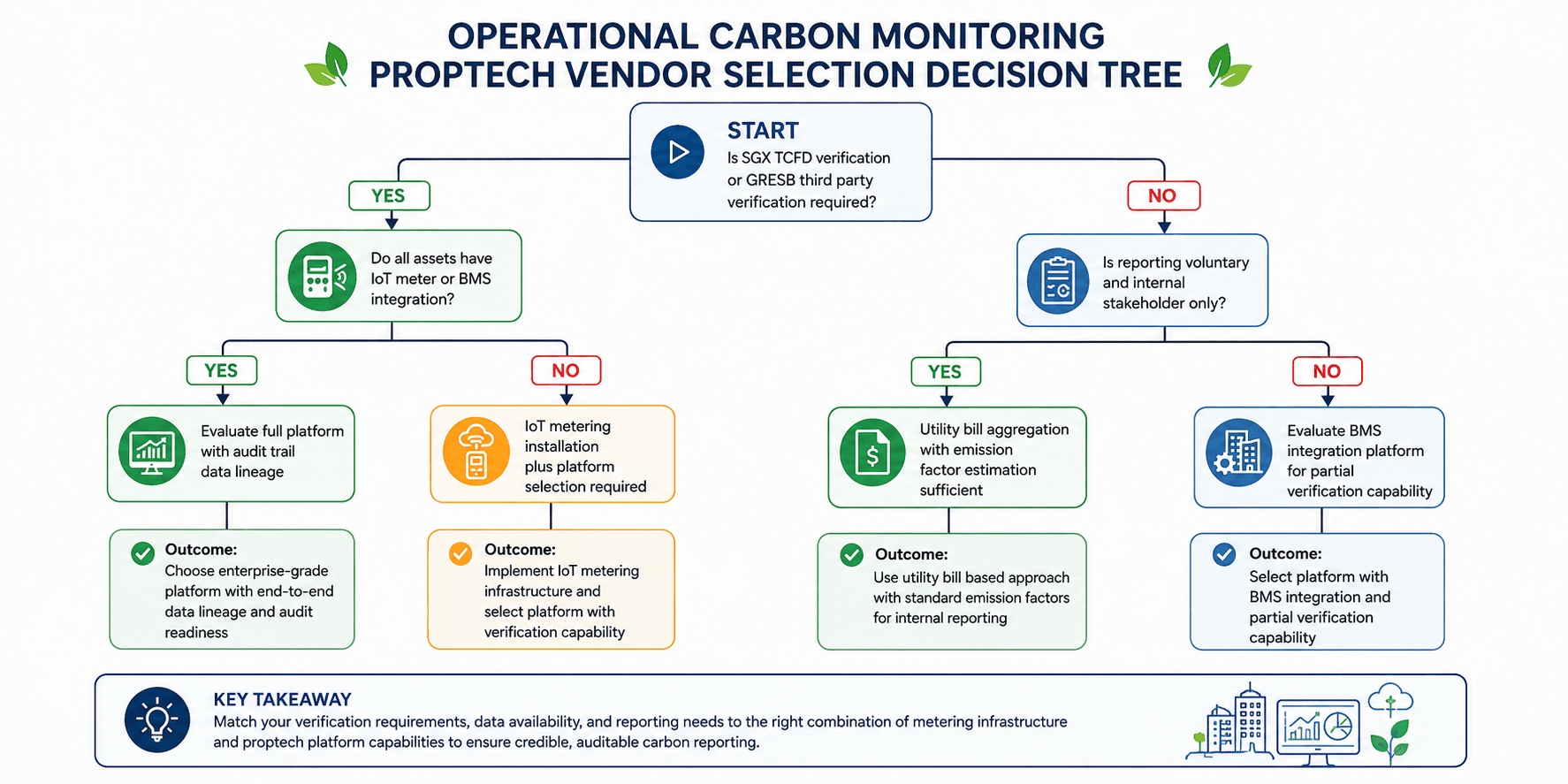
Implement full IoT meter level monitoring when:
Your portfolio includes assets subject to SGX mandatory TCFD disclosure or GRESB submission with third party verification
Institutional tenants are requesting verified tenancy level consumption data for their own Scope 3 reporting
Your portfolio has a formal SBTi or net zero commitment requiring a verified baseline and annual progress reporting
Green loan or green bond financing is in scope and requires Green Mark certified or equivalent verified energy performance
Utility bill aggregation with emission factor estimation is sufficient when:
ESG reporting is voluntary and internal stakeholders only, with no third party verification requirement
All assets are in a single jurisdiction with a stable grid emission factor
Tenant level consumption data is not required for lease terms or tenant retention
Prioritise proptech integration over standalone carbon monitoring when:
Your portfolio management operations (lease administration, maintenance, tenant billing) are managed in separate systems that carbon data must connect to for actionable decision making
You are evaluating a property management platform upgrade and carbon monitoring is one of several required capabilities
Need Expert Advice on Your AI Strategy?

Conclusion
Operational carbon monitoring proptech in Singapore is transitioning from a voluntary ESG reporting tool to a mandatory compliance infrastructure requirement. Portfolios that have not implemented IoT meter level data collection will not produce carbon figures that satisfy SGX TCFD third party verification, GRESB submission standards, or institutional tenant Scope 3 data requests. The vendor evaluation framework in this guide is designed to distinguish platforms that produce audit ready, metered emissions data from those that produce estimated carbon figures that look similar in a dashboard but cannot survive the verification requirements now arriving in Singapore's listed real estate market. Implement meter level infrastructure before the first mandatory disclosure cycle, not during remediation after a failed verification engagement.
About Samta
Samta.ai is a Singapore-headquartered AI Product Engineering & Data Intelligence partner helping enterprises build production-grade AI systems for regulated and data-intensive environments.We help organizations move beyond experimentation by engineering scalable, explainable, and enterprise-ready AI solutions from data foundations and model development to workflow automation and deployment.
Our capabilities combine deep AI expertise, data engineering, and product engineering to deliver measurable business impact across FinTech, BFSI, cybersecurity, regulatory technology, and enterprise operations.
Our enterprise AI products power real-world intelligence systems:
• TATVA : AI-driven data intelligence platform for governed analytics, monitoring, and operational insights
• VEDA : Explainable and audit-ready AI decisioning engine built for compliance-sensitive enterprise workflows
• CORA-Property Management Solutions: : Predictive intelligence platform for real-estate pricing, portfolio optimization, and investment analytics
Backed by ecosystem partnerships with Microsoft, Databricks, Snowflake, and AWS, Samta.ai delivers agile, cost-efficient AI engineering with faster turnaround and enterprise-grade scalability. Trusted by enterprises across FinTech, BFSI, and digital transformation initiatives, Samta.ai embeds AI governance, data privacy, and compliance-by-design principles directly into the AI lifecycle , enabling organizations to scale AI with transparency, accountability, and operational control.
Enterprises leveraging Samta.ai automate 65%+ of repetitive data, analytics, and decision workflows while maintaining governance, explainability, and measurable business outcomes. Samta.ai provides the strategic consulting, AI engineering, and data modernization expertise needed to align enterprise operations with next-generation AI transformation goals.
Frequently Asked Questions
What is operational carbon monitoring proptech?
Operational carbon monitoring proptech is software and IoT infrastructure that collects real time building energy consumption data, converts it to verified carbon emissions figures across Scope 1, 2, and 3 categories, and produces portfolio level ESG reporting aligned to GHG Protocol, GRESB, and SGX TCFD standards. It differs from basic energy dashboards by producing audit ready, meter level data lineage that connects every published carbon figure to a specific meter reading rather than a utility bill estimate.
What is scope emissions tracking for real estate portfolios?
Scope emissions tracking for real estate covers three categories: Scope 1 (direct combustion of fuels in owned building systems such as boilers, generators, and chillers), Scope 2 (purchased electricity from the grid, calculated using both location based and market based emission factors for GHG Protocol compliance), and Scope 3 (indirect emissions including tenant operations in landlord controlled spaces, embodied carbon in capital works, and business travel for managed properties). GHG Protocol compliant reporting requires all three scopes to be tracked and reported separately.
What IoT energy metering infrastructure is required for carbon monitoring in Singapore?
IoT energy metering for Singapore commercial properties requires: smart meters or pulse meters at the main incoming supply, sub meters at tenancy level for multi tenant buildings, BMS integration for HVAC, lighting, and lift systems, and API connectivity to the carbon monitoring platform with interval data (15 to 30 minute readings) rather than monthly totals. Singapore's energy monitoring system infrastructure requirement for Green Mark Platinum and Super Low Energy certification includes sub metering at the major system level as a mandatory prerequisite.
How does ESG reporting for real estate connect to SGX mandatory disclosure?
ESG reporting for real estate under SGX mandatory TCFD disclosure requires: verified Scope 1 and Scope 2 emissions data with audit trail documentation, climate related risk and opportunity disclosure aligned to TCFD four pillar framework, and for larger listed companies, limited assurance of emissions data by a qualified third party. Estimated figures from utility bills without meter level lineage will not satisfy limited assurance verification. Operational carbon monitoring proptech with IoT meter integration is the technical prerequisite for disclosure that meets this verification standard.
What is carbon intensity benchmarking and why does it matter for portfolio management?
Carbon intensity benchmarking compares a building or portfolio asset's emissions per unit of floor area (kgCO2e per square metre per year) against BCA Singapore sector benchmarks, GRESB real estate peer averages, and SBTi aligned net zero pathways. It matters for portfolio management because point in time carbon figures without benchmark context cannot identify which assets require priority capital works investment and which are already performing at or above sector standards. Benchmarking connects carbon monitoring to asset management and capital allocation decisions.