

Summarize this post with AI
Most enterprises treat data integration engineering services as a tooling purchase, then find out the tool was the easy part. The Lakehouse paper presented at CIDR 2021 by the team behind Databricks noted that every ETL step between a data lake and a warehouse adds new failure modes and leaves warehouse data staler than its source. Integration is where reliability is won or lost. The real decision is whether to build that capability in house, buy a platform, or partner with an engineering firm. This guide sets out how to choose, and what each path costs you in time, risk, and control.
Data Integration Engineering Services:
Data integration engineering services cover the design, build, and operation of pipelines that move data between source systems and an analytics platform, using batch ETL or ELT, change data capture, streaming, and API integration. Build when integration is a core differentiator and you can keep a senior team, buy when your sources are standard and connectors already exist, and partner when you need senior engineering capacity on Databricks, Snowflake, or Microsoft quickly with knowledge transferred to your team. Gartner's lakehouse market research lists batch ingestion, CDC, stream ingestion, and file transfer as the ingestion patterns any option must cover.
What data integration engineering services include
What are data integration engineering services? They are the engineering work that connects operational systems, such as core banking, ERP, CRM, and logistics platforms, to a central analytics environment, then keeps that connection reliable over time. The work spans ETL/ELT design, data pipelines, CDC, API integration, schema management, monitoring, and recovery.
It is different from buying a connector library. A connector moves data from A to B. Engineering decides what moves, when, in what shape, and how failures are caught. Our guide to enterprise data integration engineering covers the full scope of that work. Teams new to the topic often ask where to begin. Our walkthrough of how enterprise data integration works in practice explains the stages from source mapping through to production monitoring.
Ready to Scale AI? Start with a Free Assessment
Why the build, buy, or partner question matters now
Data engineering services decisions carry more weight in 2026 because AI workloads depend on integration quality more than any earlier analytics did. A dashboard tolerates a delayed or duplicated record. A model or agent repeats it at scale. Integration also determines whether data is ready for AI at all. Our guide to AI ready data engineering covers the quality, lineage, and governance properties integration has to preserve on the way into the platform.
Before choosing a delivery option, it helps to know what you are integrating. Our piece on data discovery for AI explains how to inventory sources and assess their condition first, since scope drives cost under every option. The architecture matters too. The CIDR lakehouse paper argued that a two tier lake plus warehouse design forces continuous ETL, duplicate storage, and proprietary format lock in, which is why many enterprises now converge on a single lakehouse layer. Gartner's market research on data lakehouse platforms describes the same converged design.
Finally, the wider platform has to be sound. Our overview of enterprise AI data infrastructure covers how integration sits alongside storage, governance, and serving layers.
How to decide: build, buy, or partner
Should we build or buy data integration? Five questions settle most enterprise data integration strategy decisions, and they are worth answering in this order.
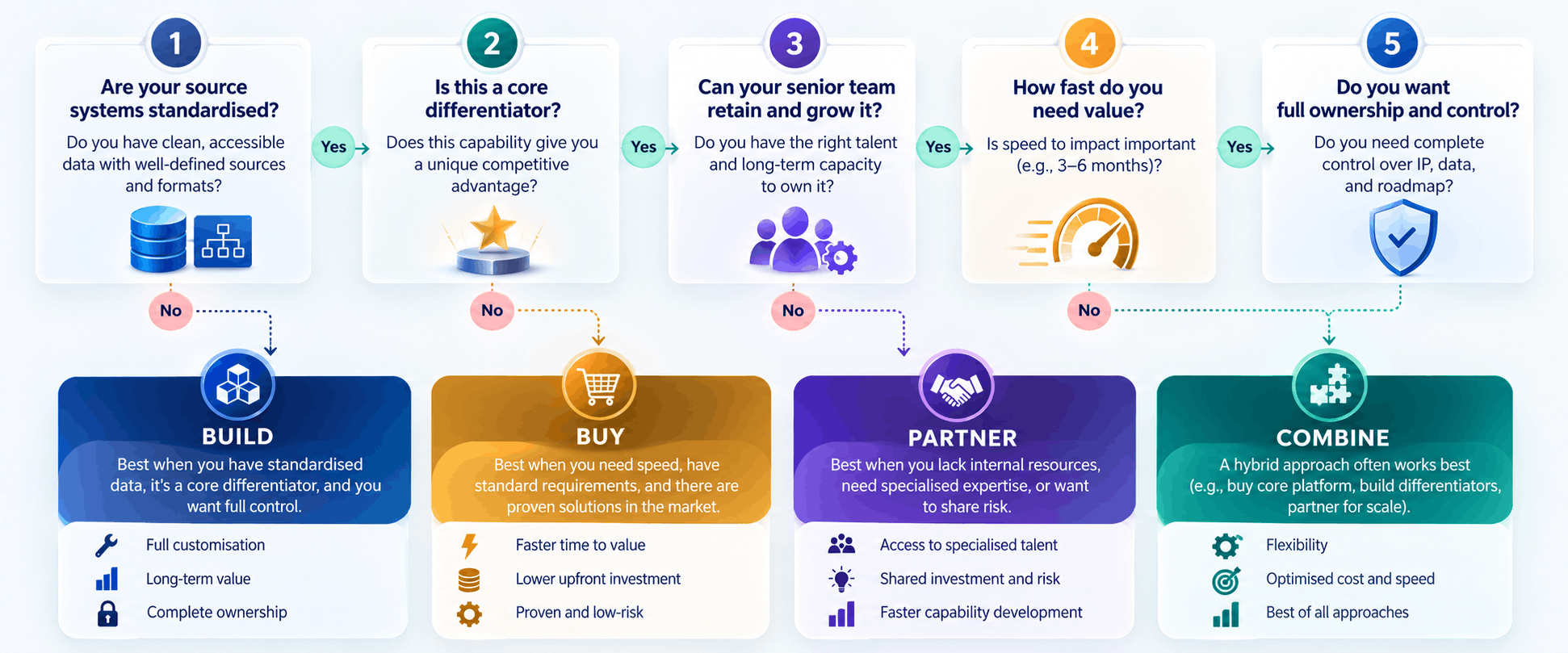
How standard are your sources? If most systems have mature connectors, buying covers the bulk of the work. Custom APIs, legacy databases, and unusual formats push toward build or partner.
Is integration a differentiator or a utility? If your edge depends on proprietary data handling, own it. If integration simply feeds analytics, treat it as a utility and avoid reinventing it.
Can you hire and keep senior data engineers? Building only works if the team stays. A single departure can stall a pipeline estate nobody else understands.
How fast do you need results? Hiring takes months. A partner or a bought platform can start sooner, which matters when a use case has a deadline.
What must you own afterwards? Whatever the route, define who owns design, code, and runbooks once the work ends, so the answer is never ambiguous.
Most enterprises land on a mix, buying connectors for standard sources and partnering for the design and custom work. Samta.ai's data integration consulting services take that approach, working with existing Databricks, Snowflake, or Microsoft environments rather than requiring a rebuild before work starts. Once data is flowing, it needs a place to be used. The VEDA AI data analytics platform consumes integrated data directly, so analysis does not wait on another export step.
Where the analytics platform fits
An integration programme is only as useful as what sits on top of it. Teams comparing options should see how VEDA compares to other data intelligence platforms, since most general tools were not designed around answering business questions directly from integrated data. The VEDA platform is built to connect to existing warehouse and lakehouse environments, which keeps the integration investment useful whichever delivery option you choose.
Build, buy, partner, or combine: at a glance
Exact fees vary by scope, team seniority, and vendor, so the table describes typical shape rather than a quoted price. Source Required for specific figures, most likely from vendor proposals or an independent benchmark.
Option | Best For | Typical Time to Value | Cost Profile | Main Risk |
Build in house | Integration as a core differentiator with a stable senior team | Slowest, hiring and design come first | Salaries and retention, ongoing | Key person dependency and slow delivery |
Buy an ETL/ELT platform | Standard sources covered by existing connectors | Fast for supported sources | Licence or consumption fees, scales with volume | Gaps for custom sources and rising usage cost |
Partner with an engineering firm | Senior capacity needed quickly on Databricks, Snowflake, or Microsoft | Fast, depends on scoping quality | Project or retainer fees, bounded | Weak handover leaves you dependent |
Combine a bought platform with a partner | Mixed estates with standard and custom sources | Fast, with a managed scope | Licence fees plus bounded project fees | Unclear ownership between tool and partner |
Managed service | Teams without capacity to run pipelines day to day | Fast to start, steady state after | Monthly retainer or subscription | Less internal knowledge of the estate |
Identify Your AI Model Risk Before It Becomes a Business Issue
Real world enterprise use cases
BFSI: a bank consolidating core banking, cards, and lending data
A bank needed a single view of customer data across core banking, cards, and lending to support a credit risk model. It bought connectors for its standard systems, used CDC for the core ledger, and brought in a partner to build the custom pipelines for a legacy lending platform. Reviewing Samta.ai's case studies helped the team judge how long comparable consolidations take before it commits to a timeline.
General enterprise: a retailer unifying store, ecommerce, and supply data
A retailer wanted to unify store, online, and supply data in a Snowflake environment. It chose to buy a managed ELT platform for common sources and kept a small in house team for the few feeds that were genuinely specific to its business. The split kept costs predictable and avoided building plumbing that a standard connector already handled.
Key risks and failure modes
Buying a tool before mapping sources. Connector coverage often looks complete until the first legacy system appears.
Building without a retention plan. A pipeline estate understood by one engineer is a risk, not an asset.
Partnering without a handover requirement. Without documented ownership, the partner becomes a permanent dependency.
Ignoring failure handling. Each pipeline step adds a point of failure, so monitoring and recovery belong in scope from the start.
Treating integration as a one time project. Source systems change, so pipelines need ongoing ownership and testing.
When to build, when to buy, and when to partner
Build when:
Integration logic is a source of competitive advantage
You can recruit and retain senior engineers for the long term
Timelines allow for a realistic hiring and design cycle
Buy when:
Most sources are standard and well covered by connectors
You want predictable setup time and managed maintenance
Volume and cost growth are well understood
Partner when:
You need senior capacity on Databricks, Snowflake, or Microsoft quickly
Custom sources or legacy systems need specialist engineering
You want a defined handover and knowledge transfer
Conclusion
Data integration engineering services succeed when the delivery model fits the estate. Build where integration is your edge, buy where connectors already exist, and partner where you need senior capacity and a clean handover. Most enterprises combine all three, and the ones that decide deliberately avoid the stalled pipelines and surprise costs that unplanned integration tends to create.
Let’s Find the Right AI Approach for Your Business
About Samta
Samta.ai is a Singapore-headquartered AI Product Engineering & Data Intelligence partner helping enterprises build production-grade AI systems for regulated and data-intensive environments.We help organizations move beyond experimentation by engineering scalable, explainable, and enterprise-ready AI solutions from data foundations and model development to workflow automation and deployment.
Our capabilities combine deep AI expertise, data engineering, and product engineering to deliver measurable business impact across FinTech, BFSI, cybersecurity, regulatory technology, and enterprise operations.
Our enterprise AI products power real-world intelligence systems:
• TATVA : AI-driven data intelligence platform for governed analytics, monitoring, and operational insights
• VEDA : Explainable and audit-ready AI decisioning engine built for compliance-sensitive enterprise workflows
• CORA-Property Management Solutions: : Predictive intelligence platform for real-estate pricing, portfolio optimization, and investment analytics
Backed by ecosystem partnerships with Microsoft, Databricks, Snowflake, and AWS, Samta.ai delivers agile, cost-efficient AI engineering with faster turnaround and enterprise-grade scalability. Trusted by enterprises across FinTech, BFSI, and digital transformation initiatives, Samta.ai embeds AI governance, data privacy, and compliance-by-design principles directly into the AI lifecycle , enabling organizations to scale AI with transparency, accountability, and operational control.
Enterprises leveraging Samta.ai automate 65%+ of repetitive data, analytics, and decision workflows while maintaining governance, explainability, and measurable business outcomes. Samta.ai provides the strategic consulting, AI engineering, and data modernization expertise needed to align enterprise operations with next-generation AI transformation goals.
Frequently asked questions
What are data integration engineering services?
They are the engineering work of designing, building, and operating the pipelines that move data from source systems into an analytics platform, including ETL or ELT, change data capture, streaming, API integration, monitoring, and failure recovery.
Should we build or buy data integration?
Buy when your sources are standard and covered by connectors, build when integration is a core differentiator and you can retain senior engineers, and partner when you need specialist capacity quickly. Many enterprises combine buying for standard sources with partnering for custom ones.
What is the build versus buy decision for enterprise data integration based on?
It rests on source complexity, whether integration is a differentiator, your ability to hire and keep engineers, your timeline, and who must own the pipelines afterwards. Answering those five questions in order settles most cases.
How much do data engineering services cost?
Cost varies with scope, source complexity, team seniority, and delivery model, and no single verified benchmark applies across vendors. Ask for itemised proposals that name the team, deliverables, and pricing structure rather than comparing headline rates.
How do I choose among data engineering providers in India for Databricks and Snowflake?
Look for demonstrated delivery on your target platform, a scoped first engagement, clear handover terms, and references from similar sectors. Verify any claimed partner status directly with the platform vendor instead of relying on a provider's own description.
What ingestion patterns should any option support?
Gartner's lakehouse research lists batch ingestion, change data capture, stream ingestion, and file transfer. Confirm that your chosen option covers the patterns your sources actually need, particularly CDC for transactional systems.