
Summarize this post with AI
Most teams searching for a codility alternative singapore assume the problem is pricing, when the real gap is usually plagiarism detection and assessment to hire correlation. Traditional coding assessment platforms were built around a fixed test case model, live or take home, scored against a reference answer. That model catches obvious copying but says little about whether a candidate who passed the test actually performs well on the job. TATVA, Samta.ai's AI driven talent assessment platform, was built to close that specific gap for Singapore enterprises hiring engineering talent at scale. Here is what actually differs, and where each approach still makes sense.
Codility Alternative Singapore:
A codility alternative singapore enterprises are adopting is TATVA, an AI driven talent assessment platform that layers pattern based plagiarism detection and assessment to hire correlation tracking on top of the live and take home coding formats Codility popularized. Where Codility scores primarily against fixed test cases and similarity matching, TATVA adds AI evaluation of code quality signals and links assessment outcomes to post hire performance data, giving Singapore hiring teams evidence their assessment process is actually predictive, not just proctored.
What is TATVA?
TATVA is Samta.ai's ai talent assessment platform, built specifically for enterprises hiring software engineers at volume across BFSI, proptech, and general technology roles in Singapore. It supports both live, proctored coding interviews and asynchronous take home assessments, scored using a combination of fixed test cases and AI evaluated code quality signals rather than test case results alone.
The platform's core assessment engine is designed around three specific gaps hiring teams reported with traditional tools: weak plagiarism detection against AI generated code, no visibility into whether assessment scores actually correlate with on the job performance, and limited support for enterprise compliance requirements common in regulated Singapore industries. The underlying TATVA platform handles scoring, proctoring, and reporting in one system rather than stitching together separate tools for each function.
Identify Your AI Readiness Gaps
Why enterprises are looking beyond Codility in 2026
Software engineering skill assessment has changed faster than most legacy platforms have adapted, for three reasons.
AI generated code has outpaced similarity based plagiarism detection. Traditional plagiarism checks compare a submission against a reference database, which does not reliably catch code generated by an AI assistant rather than copied from another candidate.
Assessment to hire correlation is now a board level question. Talent acquisition leaders are being asked to justify assessment platform spend with evidence the scores actually predict job performance, not just a completion rate.
Take home versus live coding tradeoffs have shifted. Academic research on personnel selection, including the long running Schmidt and Hunter body of work on the validity of selection methods, consistently ranks structured work sample tests among the strongest predictors of job performance, which has pushed hiring teams to demand more rigorous scoring than a pass or fail test case result.
Our guide on how Singapore enterprises are rethinking technical hiring covers this shift in more regional depth, and our comparison of TATVA against traditional online assessment platforms breaks down the scoring methodology differences directly.
How TATVA's AI driven assessment framework works
TATVA's scoring pipeline adds three layers on top of the traditional fixed test case model most platforms still rely on. Each layer is designed to answer a question a fixed test case score cannot answer on its own, whether the code is original, whether it is well structured, and whether the assessment actually predicted how the candidate performed after hire.
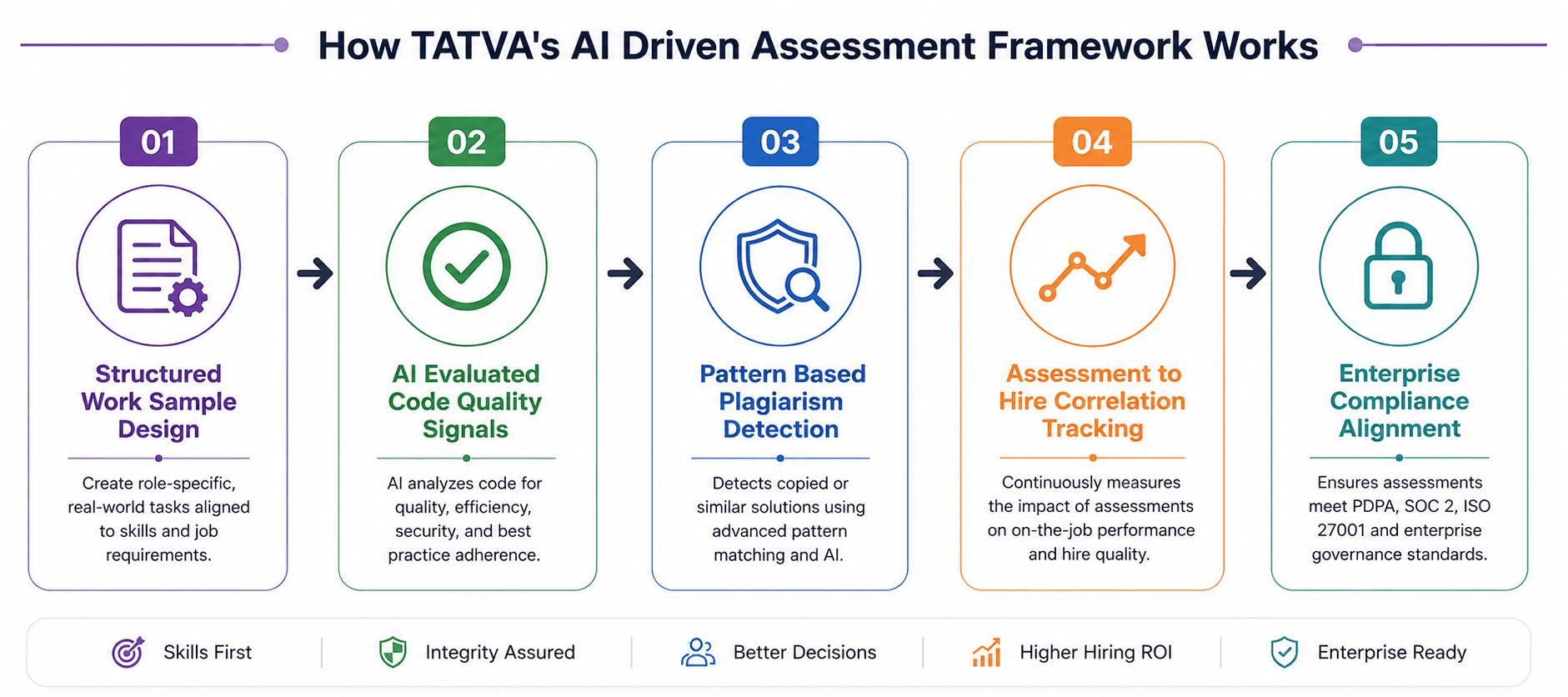
Structured work sample design. Assessments are built around realistic engineering tasks rather than algorithmic puzzles, aligned to the work sample methodology that selection research consistently ranks as most predictive.
AI evaluated code quality signals. Beyond pass or fail test cases, submissions are scored on structure, readability, and approach, not just output correctness, giving hiring managers more to discuss in a follow up interview than a single numeric score.
Pattern based plagiarism detection. Rather than relying only on similarity matching against past submissions, TATVA analyzes syntax patterns, structural signatures, and submission timing to flag likely AI generated or copied code.
Assessment to hire correlation tracking. Scores are linked, with permission, to post hire performance signals over time, giving hiring teams the evidence base most vendors in this category do not publish.
Enterprise compliance alignment. Assessment data handling is built around the data residency and audit requirements common to regulated Singapore industries from the outset, rather than added later as a compliance patch.
This is where the engineering execution layer matters. Samta.ai built TATVA's evaluation pipeline to integrate with existing HR and applicant tracking infrastructure, often alongside Databricks, Snowflake, or Microsoft data systems enterprises already run, so assessment data flows into existing reporting rather than sitting in a separate silo. Our AI driven assessment platform guide covers this integration approach in more technical depth. For regulated industries specifically, AI security and compliance services cover how assessment data handling maps to sector specific audit requirements.
Codility vs TATVA at a glance
For a fuller breakdown of how TATVA compares to traditional hiring platforms beyond Codility specifically, see our dedicated comparison. The table below summarizes the core differences.
Capability | Codility | TATVA | Assessment Format | Best For |
Live coding interviews | Proctored live environment with interviewer view | AI assisted live coding with automated scoring alongside interviewer view | Live, real time | Teams wanting interviewer control with AI support |
Take home assessments | Scored against fixed test cases | Scored against fixed test cases plus code quality signals | Asynchronous | Teams screening high volume applicant pools |
Plagiarism detection | Similarity matching against a reference database | Pattern analysis across syntax, structure, and submission timing | Automated, post submission | Teams needing defensible, auditable results |
Assessment to hire correlation | Tracked manually outside the platform | Built in tracking linking scores to post hire performance signals | Reporting dashboard | Teams validating assessment ROI over time |
Compliance and data residency | Data residency varies by plan | Built around Singapore enterprise compliance requirements from the outset | Platform level | Regulated industries needing local audit evidence |
Measure Your AI Model Risk Exposure
Real world enterprise use cases
BFSI: a bank standardizing engineering hiring across three business units
A bank running separate technical hiring processes across its digital banking, payments, and core technology units consolidated onto a single ai talent recruiting software platform to get consistent scoring and a shared plagiarism detection standard. Before consolidation, each unit had its own pass threshold and no shared view of candidate history, which meant a candidate rejected by one unit could still pass through another unrelated hiring pipeline undetected. Centralizing assessment data also gave the bank's talent team the correlation evidence its risk and audit functions asked for during a hiring process review, since audit wanted proof the assessment step was actually reducing mis hires rather than just adding a proctoring checkpoint.
General enterprise: a fast growing proptech firm scaling engineering headcount
A proptech firm scaling from twenty to eighty engineers in under a year needed a technical hiring tools singapore solution that would not require a rebuild as headcount grew. Its previous process relied on a mix of take home tests and ad hoc technical interviews with no consistent scoring rubric across interviewers, which made it difficult to compare candidates fairly once multiple hiring managers were running interviews in parallel. Reviewing its approach against our overview of enterprise AI engineering in Singapore helped the firm plan its assessment infrastructure alongside its broader engineering platform decisions, rather than treating hiring tooling as a separate purchase made in isolation from the rest of its technology stack.
Key risks and failure modes
Assuming similarity based plagiarism detection still works. As AI code generation tools become more common, similarity matching against a reference database increasingly misses AI assisted submissions entirely, since there is no prior submission to match against.
Treating assessment scores as the only signal. No coding assessment, regardless of vendor, has published peer reviewed criterion validity data specific to software engineering roles, so scores should inform, not replace, structured interviews and reference checks.
No visibility into assessment to hire correlation. Without tracking scores against post hire performance, hiring teams cannot tell whether their assessment process is actually working or just adding friction and drop off for strong candidates.
Ignoring candidate drop off during migration. Switching assessment platforms without preserving candidate experience quality can increase drop off among strong candidates who dislike a clunky or unfamiliar new process mid pipeline.
Underestimating compliance requirements. Regulated Singapore enterprises need assessment data handling that meets sector specific audit standards, which not every global assessment vendor supports by default.
When to choose TATVA over Codility
Choose TATVA when:
You need assessment to hire correlation evidence for board or audit reporting
Your current plagiarism detection is not catching AI assisted submissions
You are hiring at volume across multiple business units and need consistent scoring
Codility or a similar traditional platform may still be enough when:
Your hiring volume is low and a single standardized test format meets your needs
You do not yet need cross platform correlation reporting
Your current setup already integrates cleanly with your applicant tracking system
Our roundup of the 8 best talent assessment platforms for Singapore enterprises and our 10 best AI hiring tools guide both cover where traditional and AI driven platforms each still fit, depending on hiring volume and reporting needs.
Move Your AI Initiative Forward With Expert Guidance

Conclusion
A codility alternative singapore enterprises choose should do more than proctor a coding test, it should give hiring teams evidence their assessment process actually predicts performance. TATVA's plagiarism detection, code quality scoring, and correlation tracking address the specific gaps traditional platforms were not built to close.
About Samta
Samta.ai is a Singapore-headquartered AI Product Engineering & Data Intelligence partner helping enterprises build production-grade AI systems for regulated and data-intensive environments.We help organizations move beyond experimentation by engineering scalable, explainable, and enterprise-ready AI solutions from data foundations and model development to workflow automation and deployment.
Our capabilities combine deep AI expertise, data engineering, and product engineering to deliver measurable business impact across FinTech, BFSI, cybersecurity, regulatory technology, and enterprise operations.
Our enterprise AI products power real-world intelligence systems:
• TATVA : AI-driven data intelligence platform for governed analytics, monitoring, and operational insights
• VEDA : Explainable and audit-ready AI decisioning engine built for compliance-sensitive enterprise workflows
• CORA-Property Management Solutions: : Predictive intelligence platform for real-estate pricing, portfolio optimization, and investment analytics
Backed by ecosystem partnerships with Microsoft, Databricks, Snowflake, and AWS, Samta.ai delivers agile, cost-efficient AI engineering with faster turnaround and enterprise-grade scalability. Trusted by enterprises across FinTech, BFSI, and digital transformation initiatives, Samta.ai embeds AI governance, data privacy, and compliance-by-design principles directly into the AI lifecycle , enabling organizations to scale AI with transparency, accountability, and operational control.
Enterprises leveraging Samta.ai automate 65%+ of repetitive data, analytics, and decision workflows while maintaining governance, explainability, and measurable business outcomes. Samta.ai provides the strategic consulting, AI engineering, and data modernization expertise needed to align enterprise operations with next-generation AI transformation goals.
Frequently asked questions
What is TATVA and how is it different from Codility?
TATVA is Samta.ai's AI driven talent assessment platform. It differs from Codility primarily in plagiarism detection method, pattern analysis rather than similarity matching alone, and in tracking assessment to hire correlation, which most traditional platforms do not offer natively.
Does TATVA support both live and take home coding assessments?
Yes. TATVA supports proctored live coding interviews and asynchronous take home assessments, scored using a combination of fixed test cases and AI evaluated code quality signals rather than test case results alone.
Can TATVA detect AI generated code submissions?
TATVA uses pattern based analysis across syntax, structure, and submission timing to flag likely AI generated or copied code, which addresses a gap in similarity based plagiarism detection tools built before AI code generation became common.
How does assessment to hire correlation tracking work?
With candidate and employee permission, TATVA links assessment scores to post hire performance signals over time, giving hiring teams evidence of whether their assessment process actually predicts job performance rather than only completion rates.
Is migrating from Codility to TATVA disruptive to an active hiring pipeline?
Migration can be planned to preserve historical assessment data and candidate history, so an active pipeline does not need to pause. Samta.ai's team maps existing assessment libraries onto TATVA before cutover.
Reduce Time-to-Hire by 70% with AI Skill Verification
TATVA helps enterprises screen, assess, and benchmark software engineers and tech talent with audit-ready AI evaluations.
Explore TATVA Platform >