
Summarize this post with AI
Only 5 percent of organizations globally qualify as AI future-built, meaning 95 percent are still figuring out how to turn AI investments into sustained business value, per BCG research cited in The Thinking Company's 2026 AI Transformation Maturity Framework. In Singapore's BFSI sector, the picture is more nuanced: 84 percent of Singapore banks say their organizations are prepared for technological and cultural change per Finastra's February 2026 research, yet the industry is simultaneously transitioning from exploratory pilots toward operationalised, compliant, and measurable adoption. AI transformation maturity BFSI is the structured framework that tells you which side of that transition your institution actually sits on. This guide covers the five-stage ai transformation maturity bfsi model, what examiners and boards expect at each level, and the six dimensions that determine whether your institution can genuinely claim a given maturity stage.
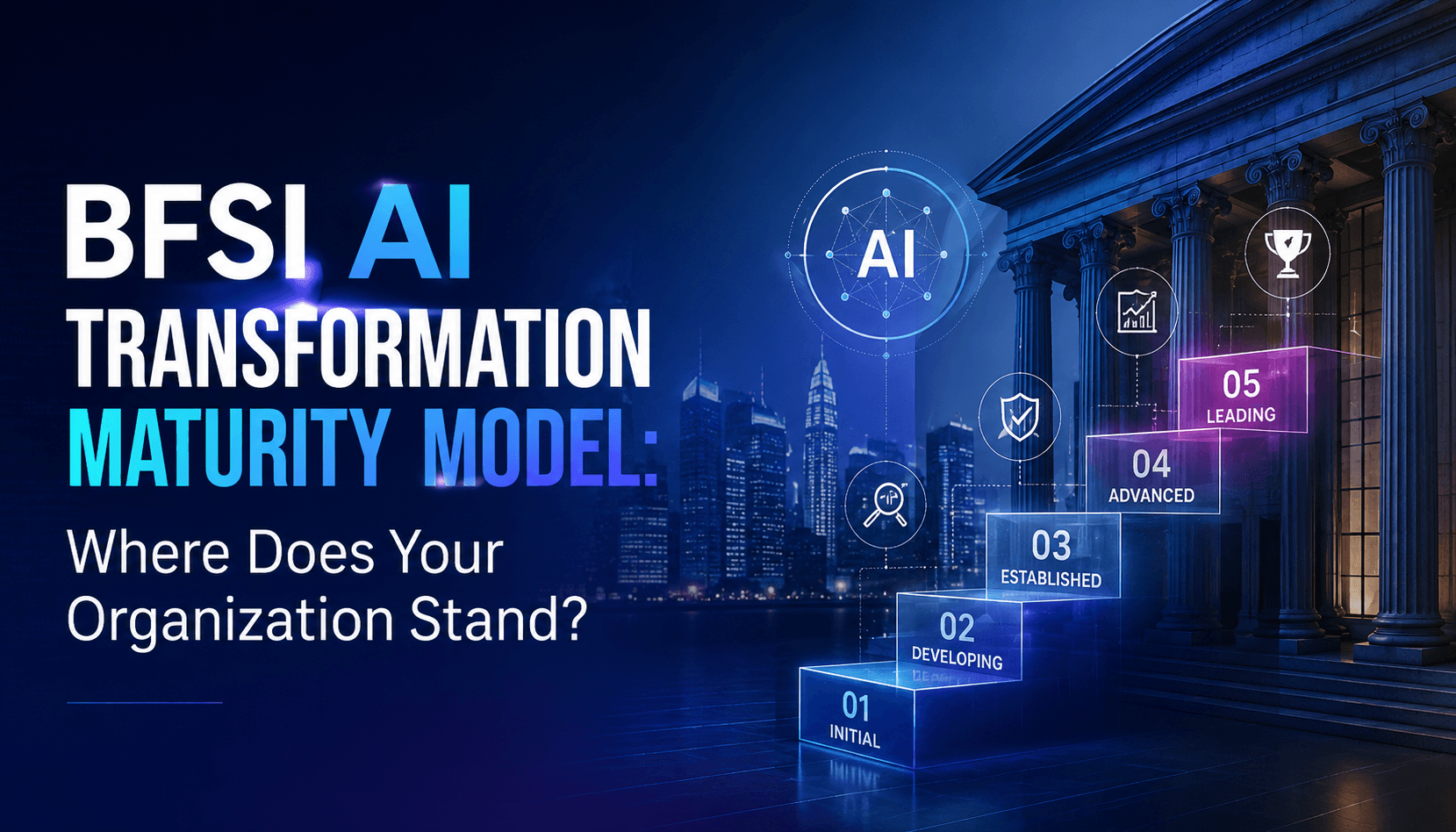
AI Transformation Maturity BFSI:
AI transformation maturity BFSI is measured across five stages Initial, Developing, Established, Advanced, and Leading and six dimensions: infrastructure, data, governance, measurement and scale, partnership, and talent. Per TCS's May 2026 Enterprise AI in BFSI whitepaper, AI maturity is best viewed as an outcome rather than a singular initiative; progress occurs when all the pillars from infrastructure to intelligence evolve in tandem, reinforcing each other. For Singapore BFSI institutions, the governance dimension carries disproportionate weight because MAS's AI Risk Management Toolkit (March 2026) and IMDA's Agentic AI framework (January 2026, updated May 2026) mean that an institution claiming Advanced or Leading maturity without documented governance and regulatory alignment is making a claim its next examination will not support.
What Is the AI Maturity Model and How Does It Apply to BFSI
What is the ai maturity model in the enterprise context: it is a structured framework that measures an organization's AI capabilities across multiple dimensions and maps them to defined stages of progression, providing a common language for assessing where you are, defining where you need to be, and planning the concrete steps to get there. Most companies know they should be doing something with AI. Far fewer know where they actually stand or what it would take to reach the next level. Enterprise ai maturity model frameworks for BFSI differ from general enterprise models in one critical dimension: governance is not a Level 4 or 5 capability in regulated financial services. It is a prerequisite for Level 3. An institution with sophisticated AI models but no documented governance, no AI inventory, and no board-level accountability is not Established in BFSI terms; it is a compliance risk with impressive demos.
The responsible ai maturity model dimension is particularly acute for Singapore BFSI enterprises. MAS's AI Risk Management Toolkit and IMDA's three-tier framework (traditional AI, generative AI, and agentic AI governance) together create a governance baseline that any credible maturity assessment must reference. For the six foundational components that underpin any responsible AI program, see the 6 components of AI governance guide. For the complete AI governance framework context these components sit within, see the complete guide to AI governance.
Evaluate Your AI Maturity with a Free Assessment
Why BFSI AI Maturity Assessment Matters More in 2026
Three structural developments make the ai business maturity model conversation a board-level priority in Singapore BFSI in 2026 rather than a planning team exercise.
1. 2026 is the year BFSI shifts from pilot to governed execution: The industry is transitioning from exploratory pilots in cloud, AI, automation, and modernisation towards operationalised, compliant, and measurable adoption. What defines 2026 is the need for practical, governed progress toward agility, resilience, and customer relevance. Institutions still operating at Stages 1 to 2 of the maturity model are now clearly behind, not just cautious.
2. Singapore banks are ahead of APAC peers but not uniformly: 84 percent of Singapore banks are prepared for technological and cultural change among the lowest unprepared rates recorded globally. However, being prepared is not the same as being mature. The institutions pulling ahead are those demonstrating Stage 4 to 5 characteristics: multi-vendor AI ecosystems, domain-specific agentic components across risk, fraud, onboarding, servicing, and customer operations, and governed intelligence built into every AI deployment.
3. MAS examination criteria now track AI maturity explicitly: Institutions that cannot demonstrate documented AI inventory, lifecycle controls, and board-level accountability during supervisory reviews are failing on criteria that have been public since November 2025. A self-assessed maturity of Stage 3 or above that cannot be supported with governance documentation is not a maturity claim; it is an examination liability.
For BFSI enterprises building the data foundation that maturity stages 3 through 5 require, the AI transformation for banks guide covers the sequencing logic, and the BFSI AI solutions governance guide documents the governance architecture that differentiates genuine Stage 3 maturity from aspirational positioning.
The Five-Stage BFSI AI Maturity Model
Use this framework to assess your institution's current maturity stage and identify the investments required to advance.
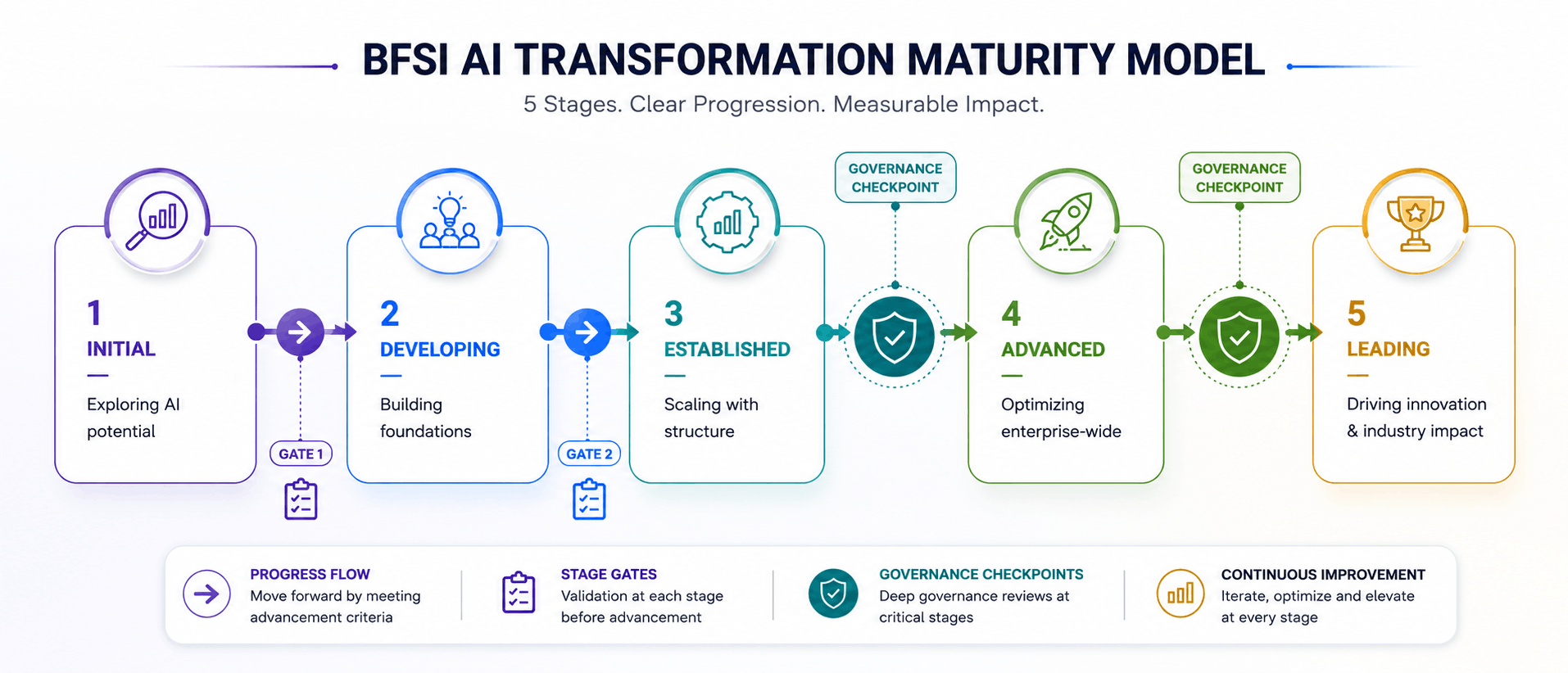
Stage 1: Initial (Ad-Hoc Experimentation)
Characteristics: Isolated AI pilots with no shared infrastructure, no governance documentation, and no cross-functional ownership. AI is deployed by individual teams without organizational coordination. Success criteria are undefined or inconsistently measured.
BFSI signature indicators: Fraud detection pilot running in one business unit with no connection to credit risk or compliance systems. No documented AI inventory. No board-level AI risk owner named.
What is required to advance: Documenting existing AI systems into a centralized inventory, assigning a named AI risk owner at the senior management level, and establishing a minimum governance policy baseline.
Stage 2: Developing (Emerging Coordination)
Characteristics: Cross-functional coordination begins. An AI strategy exists but is not fully resourced or sequenced. Data infrastructure improvements are planned. Governance policies are drafted but not operationalized.
BFSI signature indicators: An enterprise AI strategy document exists. A data governance working group is formed. MAS FEAT principles are referenced in internal policies but not yet embedded in deployment processes. Some use cases have documented ROI measurement frameworks; most do not.
What is required to advance: Moving governance from policy documents to operational controls embedded in AI deployment processes. Building a production-grade data pipeline for at least one primary AI use case.
Stage 3: Established (Operationalized AI)
Characteristics: AI is running in production for multiple business functions. Data pipelines are lineage-tracked and quality-scored. Governance controls exist in the deployment process, not just in policy documents. ROI measurement is in place for primary use cases.
BFSI signature indicators: Credit risk AI in production with MAS-aligned documentation. Fraud detection monitoring running continuously with drift detection. An AI risk register exists and is reported to the board quarterly. Model validation is conducted independently from model development.
What is required to advance: Expanding AI across additional business units with standardized infrastructure and governance rather than custom per-use-case builds. Introducing MLOps automation so model updates and retraining are repeatable without per-model custom engineering.
Stage 4: Advanced (Scaled Intelligence)
Characteristics: Organizations at Stage 4 generate substantial, measurable impact typically 5 to 15 percent improvement in key operational metrics across functions where AI is deployed. The organizational signature is standardization and repeatability. A Chief AI Officer or Chief Data and AI Officer role exists with direct CEO access. AI investment is treated as infrastructure: multi-year commitments with executive sponsorship across the C-suite.
BFSI signature indicators: Multi-vendor AI ecosystem deployed across risk, fraud, onboarding, servicing, and customer operations. Enterprise data platform with governed access on Databricks or Snowflake. Automated MLOps with CI/CD for models, drift monitoring, and automated retraining triggers. Agentic AI components in production for at least one regulated workflow with full governance documentation.
What is required to advance: Moving from standardized AI deployment to AI that continuously learns and optimizes from live business outcomes without requiring engineering intervention at each cycle.
Stage 5: Leading (AI-Native Operations)
Characteristics: AI is embedded into core business operations at the decision execution layer, not just the insight layer. Governance is continuous and automated, not periodic. The institution contributes to industry AI governance standards rather than following them. Agentic AI handles complex multi-step workflows autonomously with real-time governance oversight.
BFSI Singapore signature: Leading institutions are contributing case studies to IMDA's Model AI Governance Framework for Agentic AI as part of its living document evolution. MAS FEAT, PDPA, and AI Risk Management Toolkit compliance are automated, not manually documented.
Samta.ai's Veda AI decision analytics platform supports Stage 4 to 5 organizations by connecting model inventory, drift monitoring, bias auditing, and compliance documentation into a continuous operational layer on Databricks and Snowflake, enabling the kind of automated governance that distinguishes Stage 5 institutions from those managing governance manually. The Veda AI decision analytics platform and Veda vs data intelligence platform comparison document how this compares against general-purpose analytics platforms for governance-intensive maturity advancement. The AI security compliance services and digital transformation managed services support the Stage 3 to 4 advancement that most Singapore BFSI institutions are currently navigating.
BFSI AI Maturity Model: Six-Dimension Comparison Across Stages
Dimension | Stage 1 Initial | Stage 2 Developing | Stage 3 Established | Stage 4 Advanced | Stage 5 Leading |
Infrastructure | No shared AI infrastructure; per-pilot tooling | Cloud data platform planned or partially deployed | Production data pipelines with lineage and quality scoring | Enterprise AI/ML platform with automated MLOps; Databricks or Snowflake in production | Real-time inference infrastructure; autonomous retraining without engineering intervention |
Data | Fragmented, siloed; no governance | Data governance working group formed; CDE inventory begun | Lineage-tracked, quality-scored data pipelines for primary use cases | Governed data mesh or lakehouse serving multiple AI consumers simultaneously | Continuous data quality automation; AI self-monitors and flags data drift before model degradation |
Governance | No documented AI governance | Governance policy drafted; not embedded in deployment | MAS-aligned lifecycle controls in deployment pipeline; board reporting quarterly | Automated compliance documentation; AI risk register maintained continuously | AI governance automation feeds regulatory reporting; institution contributes to IMDA framework |
Measurement and Scale | No ROI measurement; success undefined | ROI framework designed for primary use case | P&L-connected outcome measurement for production AI systems | 5 to 15 percent improvement in key operational metrics documented; AI investment treated as multi-year infrastructure | AI contribution visible in competitive performance data, not just internal operational metrics |
Talent and Partnership | Individual team expertise only | AI strategy team formed; partner selection underway | Cross-functional AI risk committee; external specialist partner for capability acceleration | Chief AI Officer or Chief Data and AI Officer with CEO access; multi-vendor AI ecosystem managed | AI governance capability embedded in risk, compliance, technology, and business functions simultaneously |
Prepare for AI Audits with a Risk Scorecard
Enterprise Use Cases: BFSI AI Maturity in Practice
Use Case 1: Singapore Bank Advancing from Stage 2 to Stage 3
A Singapore bank self-assessed at Stage 2 after completing an internal AI inventory exercise. The inventory revealed four AI systems in production with no documented lifecycle controls, no independent model validation, and no AI risk reporting to the board. Per Deloitte's 2026 enterprise AI research, organizations that secure early wins in structured governance are 3.2 times more likely to scale AI across the enterprise. The bank structured a 90-day Stage 3 advancement program: data lineage documentation for the two highest-impact AI systems, board-level AI risk reporting framework implemented, and independent model validation process established. The AI governance maturity models guide provided the governance dimension benchmarks the team used to validate their Stage 3 claim before the next MAS supervisory review.
Use Case 2: Insurance Carrier Validating Stage 4 Maturity
A Singapore insurer believed it was operating at Stage 4 based on the breadth of AI deployments across claims, fraud, and underwriting. An independent maturity assessment found the data dimension and governance dimension were both Stage 3: AI systems were deployed at scale, but drift monitoring was manual and the compliance documentation process required engineering involvement for every MAS examiner request. Advancing the data and governance dimensions to true Stage 4 required automated MLOps deployment with drift detection and automated compliance report generation. The AI governance maturity models guide documented that Stage 4 maturity in the governance dimension requires continuous monitoring, not quarterly review cycles. The insurer's actual maturity was Stage 3.5 operationalised AI with measurement, but without automated governance.
Key Risks and Failure Modes
Self-assessment bias overstating maturity: Internal teams naturally overestimate their capabilities, particularly around data quality and governance maturity. Third-party validation is not just recommended it is essential for accurate baseline measurement. An institution that presents Stage 3 or 4 maturity to an MAS examiner and cannot support the claim with governance documentation has created a regulatory liability, not an achievement.
Treating breadth of AI deployment as evidence of maturity: A large number of AI pilots does not indicate Stage 3 maturity. AI maturity is best viewed as an outcome rather than a singular initiative — progress occurs when all the pillars evolve in tandem. An institution with 20 AI pilots but no shared infrastructure, governance, or measurement framework is Stage 1, not Stage 3.
Advancing the technology dimension without the governance dimension: BFSI is the sector where governance determines whether AI is operationally viable, not whether it is technically capable. Institutions that advance to Stage 4 infrastructure maturity while remaining at Stage 2 governance maturity have created the exact examination exposure that 2026 MAS supervisory reviews are designed to surface.
Measuring maturity once rather than continuously: Because AI capabilities evolve rapidly, maturity assessments must be updated when new AI types are deployed. A Stage 3 maturity claim validated before agentic AI was introduced does not cover agentic AI's autonomous action, tool access, and multi-agent governance requirements.
Decision Framework: Which Maturity Stage Is Your Institution At?
A documented AI inventory covers all AI systems including vendor-supplied and agentic tools → minimum Stage 2 demonstrated
MAS-aligned lifecycle controls are embedded in the AI deployment process, not just in policy documents → minimum Stage 3 demonstrated
AI risk is reported to the board quarterly with a named senior-level AI risk owner → minimum Stage 3 demonstrated
Automated MLOps with drift monitoring and CI/CD for models is live in production → minimum Stage 4 demonstrated
Compliance documentation is generated automatically rather than reconstructed per examiner request → approaching Stage 5 demonstrated
Governance controls cover agentic AI's autonomous action, tool access, and multi-agent workflows specifically → Stage 4 to 5 governance dimension
If fewer than three boxes are checked, the institution is at Stage 1 or 2. Three boxes = approaching Stage 3. Four to five boxes = Stage 4. All six = Stage 5.
Explore Your AI Opportunities in a Free Consultation

Conclusion
AI transformation maturity BFSI in 2026 is not a theoretical framework. It is the set of criteria MAS examiners reference when evaluating governance, the benchmark boards use when approving AI investment, and the diagnostic that separates institutions moving from pilot to production from those repeating the same pilot cycle. The 95 percent of organizations that are not yet AI future-built are not failing because of technology. They are failing because infrastructure, data, governance, and talent are not advancing in tandem, which is precisely what a structured maturity model is designed to reveal.
About Samta
Samta.ai is a Singapore-headquartered AI Product Engineering & Data Intelligence partner helping enterprises build production-grade AI systems for regulated and data-intensive environments.We help organizations move beyond experimentation by engineering scalable, explainable, and enterprise-ready AI solutions from data foundations and model development to workflow automation and deployment.
Our capabilities combine deep AI expertise, data engineering, and product engineering to deliver measurable business impact across FinTech, BFSI, cybersecurity, regulatory technology, and enterprise operations.
Our enterprise AI products power real-world intelligence systems:
• TATVA : AI-driven data intelligence platform for governed analytics, monitoring, and operational insights
• VEDA : Explainable and audit-ready AI decisioning engine built for compliance-sensitive enterprise workflows
• CORA-Property Management Solutions: : Predictive intelligence platform for real-estate pricing, portfolio optimization, and investment analytics
Backed by ecosystem partnerships with Microsoft, Databricks, Snowflake, and AWS, Samta.ai delivers agile, cost-efficient AI engineering with faster turnaround and enterprise-grade scalability. Trusted by enterprises across FinTech, BFSI, and digital transformation initiatives, Samta.ai embeds AI governance, data privacy, and compliance-by-design principles directly into the AI lifecycle , enabling organizations to scale AI with transparency, accountability, and operational control.
Enterprises leveraging Samta.ai automate 65%+ of repetitive data, analytics, and decision workflows while maintaining governance, explainability, and measurable business outcomes. Samta.ai provides the strategic consulting, AI engineering, and data modernization expertise needed to align enterprise operations with next-generation AI transformation goals.
Frequently Asked Questions
What is the AI maturity model and how does it apply to BFSI specifically?
An ai maturity model is a structured framework measuring AI capabilities across defined dimensions including infrastructure, data, governance, measurement, and talent, mapped to stages from Initial through Leading. For ai in bfsi sector contexts, the governance dimension carries disproportionate weight because MAS examination criteria now evaluate governance maturity alongside technology capability.
What are the five stages of BFSI AI maturity?
The five stages of ai transformation maturity bfsi are Initial (isolated pilots, no governance), Developing (emerging coordination, governance drafted), Established (AI in production with lifecycle controls), Advanced (scaled across business functions with automated MLOps and 5 to 15 percent measurable impact), and Leading (AI-native operations with automated governance and agentic AI in regulated workflows).
How is a responsible ai maturity model different from a general AI maturity model?
A responsible ai maturity model adds governance, explainability, bias monitoring, and regulatory alignment as first-class maturity dimensions rather than treating them as optional advanced capabilities. For Singapore BFSI institutions, responsible AI maturity is not Stage 4 or 5 work; it is the prerequisite for claiming Stage 3, because MAS governance documentation requirements apply to any AI in production, not just advanced deployments.
What is an ai maturity model tool and how do BFSI institutions use it?
An ai maturity model tool is a structured diagnostic that assesses an institution across the six maturity dimensions, scores each dimension against stage criteria, identifies gaps between current and target state, and produces a sequenced advancement roadmap. For BFSI institutions, a credible tool must include MAS, PDPA, and IMDA MGF alignment as explicit scoring criteria in the governance dimension.
Why does BFSI AI maturity assessment require third-party validation?
Internal teams naturally overestimate capabilities, particularly around data quality and governance maturity. Third-party validation is essential because self-assessed maturity that cannot be supported with governance documentation creates regulatory liability. An institution presenting Stage 3 or 4 maturity to MAS examiners and failing to substantiate the governance dimension during inspection is in a worse position than an institution that honestly claims Stage 2 and has a documented advancement plan.