
Summarize this post with AI
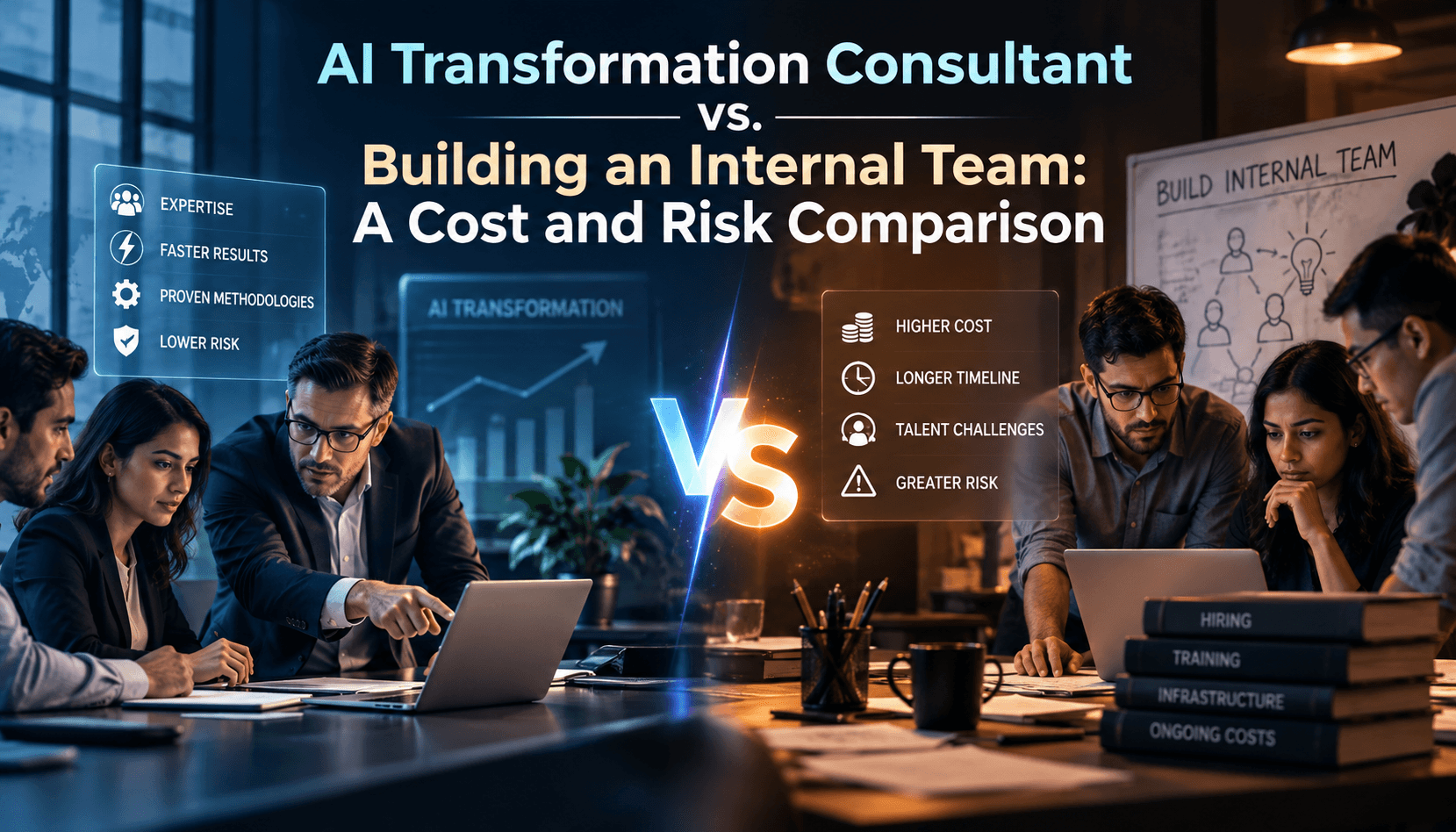
Most CTOs frame ai transformation consultant vs internal team as a simple cost comparison, consultant day rate against a salary line. That framing misses the bigger variable, Singapore's AI engineering talent market is structurally tight, and hiring timelines now compete directly against how fast a business actually needs results. A consultant deploys existing expertise immediately but leaves governance ownership as an open question after the engagement ends. An internal team builds durable ownership from day one but has to survive a hiring market where job vacancies outnumber unemployed workers by a wide margin. Here is what each path actually costs, and where a hybrid model beats picking one over the other.
AI Transformation Consultant vs Internal Team:
Ai transformation consultant vs internal team decisions should weigh time to production against durable governance ownership, not cost alone. A consultant typically deploys faster since hiring cycles are removed entirely, while an internal team costs more upfront in a tight labor market but retains AI governance accountability inside the organization rather than requiring a handoff once an engagement ends. Singapore's labor market remained tight through late 2025, with job vacancies reaching 77,700 in December 2025 against a vacancy to unemployed ratio of 1.58, according to the Ministry of Manpower, meaning internal hiring timelines are a real cost, not a rounding error, in this decision.
What AI transformation consulting actually is
What is ai consulting? It is engaging an external firm to plan, build, and often initially operate AI systems on an organization's behalf, ranging from strategy advisory through to full technical delivery, depending on the engagement scope. This differs from ai in consulting industry discussions about consulting firms using AI internally, the focus here is firms that provide AI transformation as a service to their clients.
What is ai transformation? It is the broader organizational shift toward AI embedded decision making and workflow automation, not a single project but an ongoing capability an organization needs to sustain. Our guide on AI consultant versus AI covers this distinction between hiring help and building the capability directly in more depth, and our overview of building an internal AI team covers what that capability actually requires once an organization commits to owning it.
Identify AI Gaps with a Free Assessment Report
Why this decision carries more weight in 2026
Hire ai consultant vs build in house decisions now hinge on three specific pressures that were less acute even a year or two ago.
Talent scarcity is structural, not cyclical. Multiple 2026 industry salary surveys report a sustained premium for AI and machine learning engineering roles over general software engineering positions in Singapore, reflecting genuine scarcity rather than a temporary spike.
Time to production has become a board level metric. With Singapore's overall labor market this tight, a hiring plan that assumes a fast internal build often underestimates how long sourcing genuinely qualified AI talent actually takes.
Opportunity cost compounds while a team is being built. Every month spent recruiting is a month competitors, some of whom chose the consulting route, are already in production with a working system.
Our guide on AI implementation alternatives to consulting and our overview of AI transformation consulting in Singapore both cover how this pressure is reshaping typical engagement structures.
How to decide: a framework for the build versus buy decision
Working through this decision systematically avoids defaulting to whichever option feels more familiar.
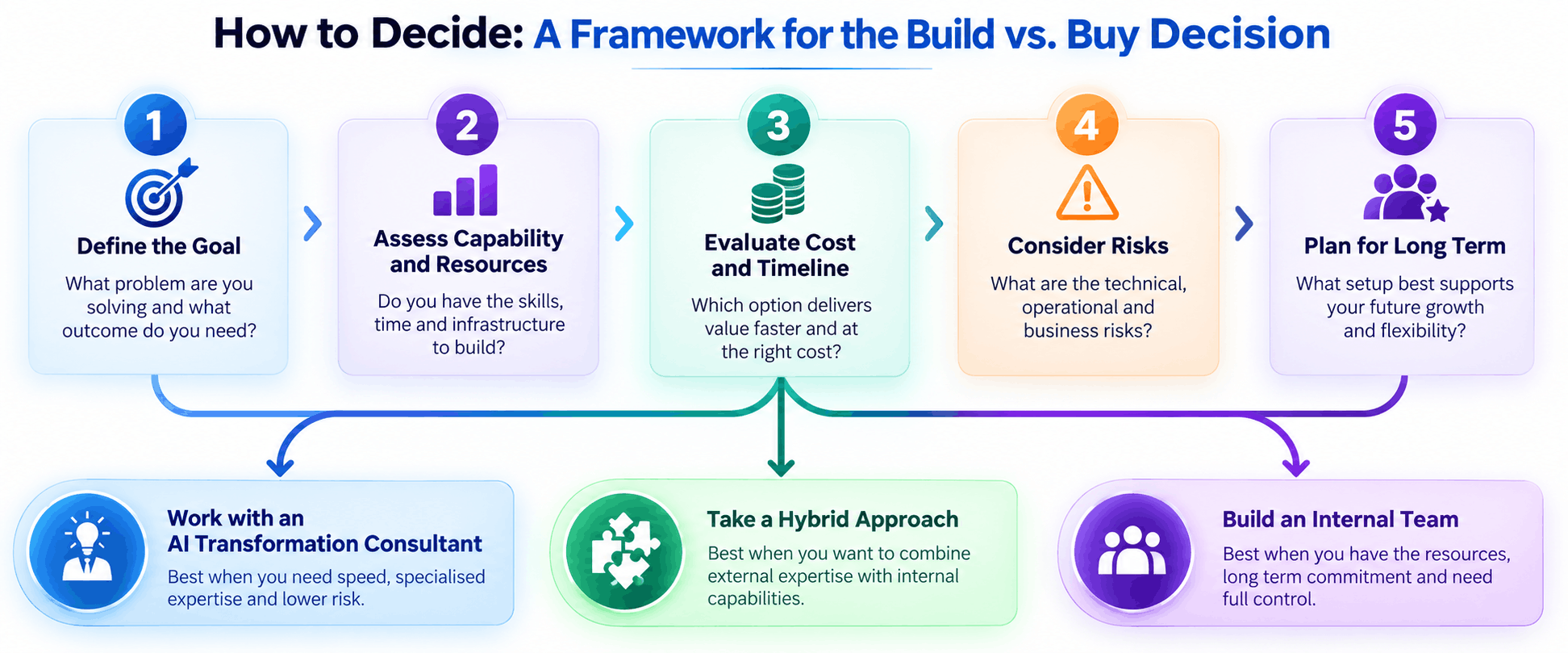
Score your time to production requirement. A board expectation of results within one or two quarters strongly favors a consultant or hybrid model, since internal hiring alone can take that long.
Assess your access to AI specific talent. Organizations without an existing AI team to build around face a materially harder hiring market than those extending an established function.
Determine your governance ownership requirement. Regulated industries needing durable, internally accountable AI governance may need to plan for an internal team even if a consultant builds the initial system.
Model the true cost of both paths, not just the visible one. Consultant fees are visible upfront; internal hiring costs include recruitment time, onboarding, and the retention premium the current talent market demands.
Consider a hybrid model before committing fully to either extreme. A consultant can build the initial system while an internal team forms in parallel, taking ownership progressively rather than starting from zero after the engagement ends.
This is where the engineering execution layer matters, on both sides of the decision. For organizations building internally, the harder part is rarely finding candidates, it is verifying they can actually do the work in a market where qualified AI engineers are scarce and inflated resumes are common. Samta.ai's TATVA hiring assessment platform gives hiring teams AI specific technical assessments built for exactly this scarcity, rather than relying on generic coding tests that do not distinguish genuine AI engineering skill from surface familiarity with popular frameworks. Institutions weighing TATVA against a standard hiring process should see how TATVA compares to traditional hiring platforms, and the TATVA platform itself is built specifically around the technical assessment gap that makes internal AI hiring slower and riskier than it needs to be. For the consultant or hybrid path, our data integration consulting services ensure a consultant led build integrates with existing Databricks, Snowflake, or Microsoft infrastructure rather than locking an organization into a closed system a future internal team cannot maintain, and our digital transformation managed services hand over operational ownership progressively as an internal team is built up, rather than requiring an abrupt handoff on a fixed engagement end date.
AI transformation consultant vs internal team at a glance
Dimension | AI Transformation Consultant | Internal Team | Typical Timeline | Best For |
Cost Structure | Project or retainer fee, no long term payroll commitment | Salary, benefits, and a structural market premium for AI roles | Consultant scopes in weeks, internal hiring in months | Firms uncertain about long term AI headcount needs |
Time to Production | Existing expertise deploys with no hiring cycle | Hiring alone can take months in a tight talent market | Consultant deploys materially faster | Firms needing results within one or two quarters |
Talent Risk | Risk sits with the vendor, not the firm's retention | Departure of a key engineer can stall the entire program | Ongoing consideration for both paths | Firms without an existing AI team to build around |
Governance Ownership | Vendor builds it, firm must absorb ownership after engagement ends | Governance stays inside the organization from day one | Internal ownership takes longer to establish but is more durable | Regulated firms needing durable internal accountability |
Scalability | Scales up or down with project scope | Scaling requires additional hiring in a constrained market | Hybrid models blend both approaches | Firms planning sustained, multi year AI investment |
Evaluate Your AI Models with a Risk Exposure Scorecard
Real world enterprise use cases
BFSI: a bank choosing a hybrid model for a model risk platform
A bank needed a model risk governance platform live within two quarters, a timeline that ruled out building an internal team from scratch given the current hiring market. Bringing in a consultant to build the initial system, supported by AI security and compliance services, while recruiting an internal governance lead in parallel, meant the bank had a working system on time and durable internal ownership within the following two quarters.
General enterprise: a SaaS firm building internal capability from the start
A SaaS firm with a longer runway and no immediate board pressure for fast results chose to build an internal AI team from the outset, accepting a slower initial timeline in exchange for full internal ownership of its product roadmap. Reviewing AI consulting for SaaS firms specifically helped the company scope which early stage work still made sense to bring in outside help for, even while committing to an internal build long term. The firm's broader technology planning also drew on our overview of enterprise AI engineering in Singapore, which helped it sequence internal hiring alongside its wider infrastructure roadmap rather than treating team building as an isolated workstream.
Key risks and failure modes
Underestimating internal hiring timelines. Organizations that assume a fast internal build in a structurally tight talent market frequently miss board level deadlines by a wide margin.
Assuming a consultant engagement transfers governance automatically. Without an explicit handoff plan, governance ownership can sit in an ambiguous state once a consulting engagement ends.
Comparing only visible costs. Consultant fees are easy to see upfront; the true cost of internal hiring, including recruitment time and retention premiums, is often underestimated.
Choosing one path without considering a hybrid model. Organizations that treat this as a binary choice miss the option of a consultant led build with progressive internal ownership.
Building internal capability without addressing retention risk. A single key engineer's departure can stall an entire internal AI program if institutional knowledge was never documented or shared.
When to choose a consultant, an internal team, or a hybrid
Choose a consultant when:
Board level timelines require results within one or two quarters
No existing internal AI team exists to build around
The initiative's scope is well defined and unlikely to need continuous internal iteration
Choose an internal team when:
Governance ownership must remain durably inside the organization from the outset
The AI initiative is core to the product roadmap and needs continuous internal iteration
Timeline pressure is lower, allowing for a realistic hiring cycle in the current market
Choose a hybrid model when:
You need fast initial deployment but also durable long term ownership
Internal hiring is underway but will take longer than the business timeline allows
You want to reduce retention risk by pairing a consultant's delivery capacity with internal team formation
Our comparison of AI focused development against traditional development companies covers this decision from the vendor selection angle in more depth. Reviewing Samta.ai's case studies alongside your own timeline and talent access gives a useful benchmark for which path fits your specific situation.
Get Personalized AI Consulting for Your Organization
Conclusion
Ai transformation consultant vs internal team is not a decision cost alone should settle. Time to production, talent market realities, and governance ownership all carry real weight, and a hybrid model often outperforms picking one extreme. Organizations that model all three factors honestly make a better decision than those defaulting to whichever option feels most familiar.
About Samta
Samta.ai is a Singapore-headquartered AI Product Engineering & Data Intelligence partner helping enterprises build production-grade AI systems for regulated and data-intensive environments.We help organizations move beyond experimentation by engineering scalable, explainable, and enterprise-ready AI solutions from data foundations and model development to workflow automation and deployment.
Our capabilities combine deep AI expertise, data engineering, and product engineering to deliver measurable business impact across FinTech, BFSI, cybersecurity, regulatory technology, and enterprise operations.
Our enterprise AI products power real-world intelligence systems:
• TATVA : AI-driven data intelligence platform for governed analytics, monitoring, and operational insights
• VEDA : Explainable and audit-ready AI decisioning engine built for compliance-sensitive enterprise workflows
• CORA-Property Management Solutions: : Predictive intelligence platform for real-estate pricing, portfolio optimization, and investment analytics
Backed by ecosystem partnerships with Microsoft, Databricks, Snowflake, and AWS, Samta.ai delivers agile, cost-efficient AI engineering with faster turnaround and enterprise-grade scalability. Trusted by enterprises across FinTech, BFSI, and digital transformation initiatives, Samta.ai embeds AI governance, data privacy, and compliance-by-design principles directly into the AI lifecycle , enabling organizations to scale AI with transparency, accountability, and operational control.
Enterprises leveraging Samta.ai automate 65%+ of repetitive data, analytics, and decision workflows while maintaining governance, explainability, and measurable business outcomes. Samta.ai provides the strategic consulting, AI engineering, and data modernization expertise needed to align enterprise operations with next-generation AI transformation goals.
Frequently asked questions
Is it cheaper to hire an AI consultant or build an internal team?
It depends on the timeline. A consultant avoids the hiring cycle entirely, which is valuable given Singapore's tight labor market, while an internal team costs more upfront in salary and retention premiums but avoids ongoing engagement fees once built.
How long does it typically take to build an internal AI team in Singapore?
Given the structural talent premium and tight overall labor market, with job vacancies at 77,700 in December 2025 against a vacancy to unemployed ratio of 1.58, sourcing qualified AI talent internally often takes considerably longer than most initial hiring plans assume.
What is a hybrid model for AI transformation?
A hybrid model uses a consultant to build the initial AI system quickly while an internal team forms in parallel, taking over ownership progressively rather than requiring an abrupt handoff once a fixed consulting engagement ends.
Does using an AI consultant mean losing control of governance?
Not necessarily, but it requires an explicit handoff plan. Without one, governance ownership can remain ambiguous once an engagement ends, which is why the transition plan should be scoped before the engagement begins, not after.
When does building an internal AI team make more sense than hiring a consultant?
Internal teams make more sense when governance ownership must remain durably inside the organization, the AI initiative is core to the ongoing product roadmap, and the business timeline allows for a realistic hiring cycle in a tight market.