
Summarize this post with AI
A risk register with no named owner is a wish list, not a control. An ai risk assessment template only works when every risk has an assigned owner, a mapped control and a scored residual risk, not just a description. This piece gives you the structure for a 25 risk AI register, built around categories most teams miss entirely.
AI risk assessment template:
An effective AI risk assessment template organises risks by category, data, model, governance, third party and operational, and scores each one by likelihood and impact, with a named risk owner, a mapped control and a documented residual risk after that control is applied. This structure aligns with both the NIST AI Risk Management Framework and ISO/IEC 42001, the world's first certifiable AI management system standard, published in December 2023. For enterprise and BFSI teams in Singapore and the wider APAC region, the most commonly missing category is third party AI risk, vendor supplied and embedded models that rarely appear on an internal register at all.
What should an AI risk assessment include?
An ai risk assessment evaluates the risks an AI system introduces across its full lifecycle, from the data it trains on through to how its output is used in a real decision. A complete ai risk register differs from a general risk list by requiring four specific fields per entry: the risk itself, a named risk owner, a mapped control, and a likelihood and impact score that produces a residual risk rating after the control is applied.
Related terms include the ai risk assessment framework, the structured method used to score and categorise risks consistently, and ai third party risk management, the specific practice of extending this same rigor to vendor supplied and embedded AI systems. For a deeper breakdown of what counts as a complete framework, see what is an AI risk assessment and AI risk compliance against NIST.
Need Better Insights for Critical Business Decisions?
Why this matters now for enterprise and BFSI teams
Three developments make a properly structured register essential in 2026.
A certifiable global standard now exists specifically for AI. ISO/IEC 42001:2023, published by ISO and IEC in December 2023, is the world's first international standard for an AI management system, giving organisations an auditable structure for exactly the kind of risk register this template builds.
Technical risk management guidance reinforces the same discipline. The NIST AI Risk Management Framework, structured around govern, map, measure and manage functions, expects organisations to document risks with the same rigor ISO 42001 requires for certification.
Regional regulators are converging on the same expectations. MAS's proposed AI Risk Management Guidelines for Singapore financial institutions expect a complete model and risk inventory, the same foundational artefact this register provides.
See how this connects to the broader governance picture in AI governance framework versus a standalone risk register, and AI model risk management for the model specific layer underneath it.
A five step framework for building the register
Here is how to build a complete, defensible AI risk register rather than a generic checklist.
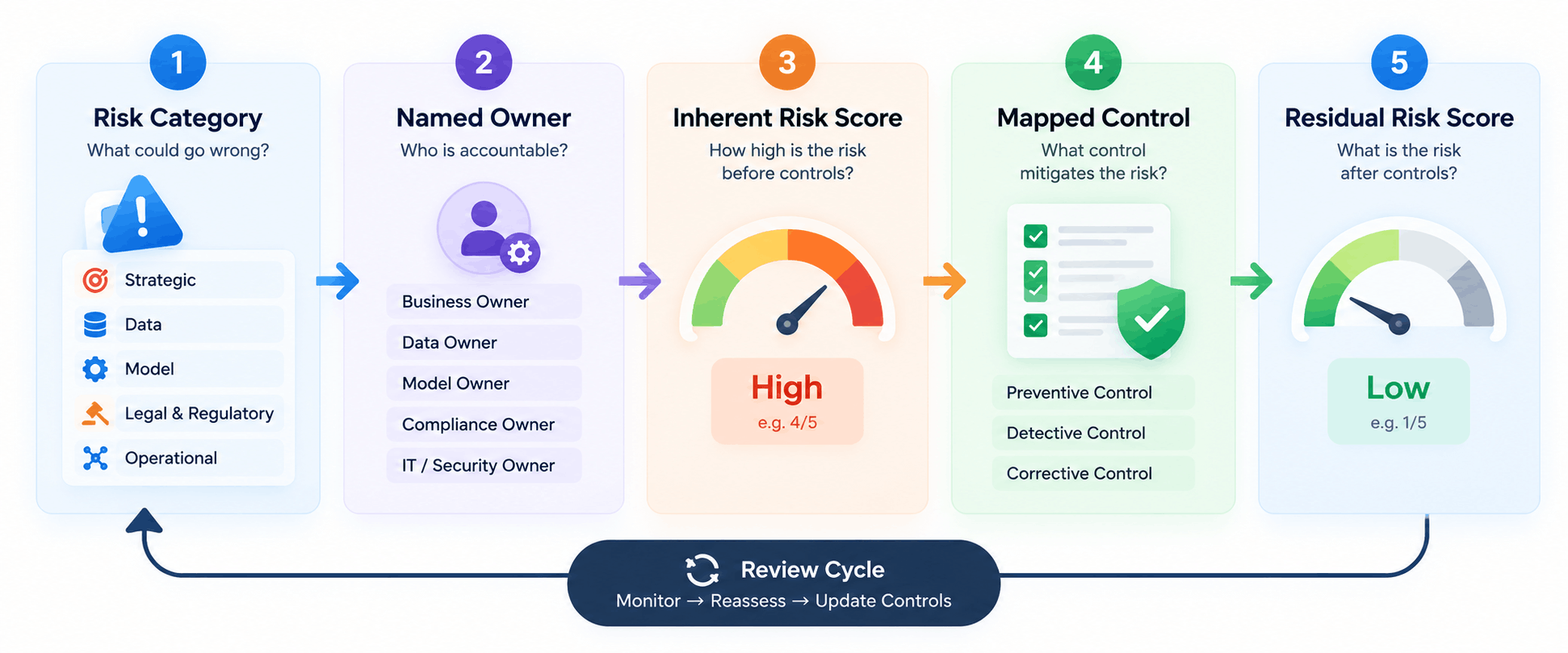
Categorise risks across five areas. Cover data risk, model risk, governance risk, third party risk and operational risk separately, since each category requires different evidence and different owners.
Assign a named risk owner to every entry. A risk without an accountable individual, not a team or department, rarely gets closed. AI security and compliance services support organisations building this ownership structure directly.
Score likelihood and impact before any control is applied. This gives you inherent risk, the baseline severity before mitigation, which matters for prioritisation.
Map a specific control to each risk, then score residual risk. Residual risk, the severity remaining after the control is applied, is what regulators and auditors actually want to see, not the inherent risk alone.
Review and update the register on a fixed cycle. A register built once and never revisited misses new models, new vendors and new risks as they appear. Samta.ai's Veda platform and the Veda AI data analytics platform support this step directly, keeping risk and control data traceable across connected systems rather than living in a static spreadsheet.
Sample register structure: five risks across five categories
Risk category | Example risk | Risk owner | Control mapped | Residual risk |
Data | Training data contains unaddressed bias | Head of Data Governance | Documented bias testing before deployment | Medium |
Model | Model accuracy drifts undetected in production | Model Risk Lead | Scheduled drift monitoring with defined thresholds | Low |
Governance | No board level accountability for AI decisions | Chief Risk Officer | Named executive sponsor per model, reviewed quarterly | Low |
Third party | Vendor supplied model excluded from inventory | Vendor Risk Manager | Third party AI added to inventory with same tiering as internal models | Medium |
Operational | No rollback plan if a production model fails | Head of AI Operations | Documented rollback and escalation procedure | Low |
This is a five row preview of the full 25 risk structure, extending the same pattern across five entries per category. For the complete, downloadable version, request the ai risk register excel template directly.
Comparing five approaches to building an AI risk register
Approach | Risk categories covered | Ownership clarity | Residual risk tracking | Best fit |
Informal risk discussion, no written register | Partial, undocumented | None | None | Not recommended for any production AI |
Generic risk template, not AI specific | Partial, misses AI specific risks | Low, roles not individuals | Weak, inconsistent scoring | Early exploration only |
Downloaded free template, unmaintained | Full at creation, stale afterward | Medium, set once | Medium, not reviewed | Small teams starting out |
ISO 42001 or NIST aligned register, manually maintained | Full, structured by standard | Strong, named owners required | Strong, scored consistently | Mid sized enterprises and regulated teams |
Integrated platform supported register with ongoing monitoring | Full, continuously updated | Strong, tied to live ownership data | Strong, automatically recalculated | Enterprise and BFSI scaling multiple AI systems |
The last row removes the manual maintenance burden that causes most registers to go stale. For a platform level comparison, see Veda versus a general Data Intelligence Platform.
Know Your AI Readiness Before Your Next Move
Real world use cases
Regulated bank: third party risk missing from the register
A bank's AI risk register covered every internally built model but excluded a vendor supplied fraud detection tool. An internal audit flagged this gap directly against ISO 42001's requirement to cover AI used, not just AI built. Adding the vendor model with the same ownership, control mapping and residual risk scoring as internal entries closed the gap before an external review could raise it independently. See related patterns in Samta.ai's case studies.
General enterprise: register built once, never updated
A manufacturer built a thorough AI risk register during an initial compliance push, then never revisited it. Eighteen months later, three new models had entered production with no corresponding register entries. Establishing a fixed quarterly review cycle, tied to the model inventory rather than a calendar reminder alone, caught the gap and kept the register current going forward.
Key risks and failure modes
Assigning risk ownership to a team instead of a named individual: Shared ownership consistently results in risks that nobody actually closes.
Scoring only inherent risk, never residual risk: Auditors and regulators want to know what risk remains after a control is applied, not just the raw severity.
Excluding third party and vendor supplied AI entirely: This is consistently the most common gap found in register reviews, under both NIST and ISO 42001 expectations.
Building the register once and treating it as finished: New models and new vendors enter production continuously, and a static register misses them.
Using generic risk categories not specific to AI: A risk register built for general IT risk misses AI specific failure modes like bias, drift and explainability gaps.
No mapped control for a listed risk: A risk entry without a specific, named control is a description, not a managed risk.
When to build a formal AI risk register, and when a lighter check is enough
Build the full register now if:
You operate any AI system with financial, customer facing or regulatory impact
You are pursuing ISO 42001 certification or preparing for an AIRG style regulatory review
You have never formally catalogued vendor supplied or embedded AI systems
A previous internal review already flagged gaps in AI risk documentation
A lighter check may be enough if:
You run a single, low risk, internal only AI tool with no production deployment
You are in very early experimentation with no committed budget yet
A current register already covers all five categories and was reviewed in the last quarter
Assess Your AI Model Risk with Confidence
Conclusion
A risk register that lists problems without owners or controls protects nobody, it just documents what everyone already suspected. The structure above turns that list into something an auditor, a regulator, or your own board can actually act on. Build it across all five categories, assign real owners, map real controls, and review it on a fixed cycle. The next step is building your own, with your actual systems in it.
About Samta
Samta.ai is a Singapore-headquartered AI Product Engineering & Data Intelligence partner helping enterprises build production-grade AI systems for regulated and data-intensive environments.We help organizations move beyond experimentation by engineering scalable, explainable, and enterprise-ready AI solutions from data foundations and model development to workflow automation and deployment.
Our capabilities combine deep AI expertise, data engineering, and product engineering to deliver measurable business impact across FinTech, BFSI, cybersecurity, regulatory technology, and enterprise operations.
Our enterprise AI products power real-world intelligence systems:
• TATVA : AI-driven data intelligence platform for governed analytics, monitoring, and operational insights
• VEDA : Explainable and audit-ready AI decisioning engine built for compliance-sensitive enterprise workflows
• CORA-Property Management Solutions: : Predictive intelligence platform for real-estate pricing, portfolio optimization, and investment analytics
Backed by ecosystem partnerships with Microsoft, Databricks, Snowflake, and AWS, Samta.ai delivers agile, cost-efficient AI engineering with faster turnaround and enterprise-grade scalability. Trusted by enterprises across FinTech, BFSI, and digital transformation initiatives, Samta.ai embeds AI governance, data privacy, and compliance-by-design principles directly into the AI lifecycle , enabling organizations to scale AI with transparency, accountability, and operational control.
Enterprises leveraging Samta.ai automate 65%+ of repetitive data, analytics, and decision workflows while maintaining governance, explainability, and measurable business outcomes. Samta.ai provides the strategic consulting, AI engineering, and data modernization expertise needed to align enterprise operations with next-generation AI transformation goals.
Frequently asked questions
What should an AI risk assessment include?
A complete AI risk assessment includes risks organised by category, data, model, governance, third party and operational, each scored by likelihood and impact before mitigation, with a named risk owner and a specific mapped control. The assessment should also record residual risk, the severity remaining after the control is applied, since that figure is what regulators and auditors typically ask for.
What is an AI risk register?
An AI risk register is a structured document listing every identified AI risk across an organisation, along with its owner, mapped control, and residual risk score. It differs from a general IT risk register by covering AI specific failure modes such as bias, model drift and explainability gaps, and by including vendor supplied and embedded AI systems alongside internally built models.
How do you score AI risks?
Score each risk on likelihood and impact before any control is applied, producing an inherent risk rating. Then apply the mapped control and rescore the same risk to produce a residual risk rating, which reflects what remains after mitigation. Consistent scoring criteria across the whole register, not ad hoc judgment per entry, is what makes the resulting scores comparable and useful for prioritisation.
Give me an AI risk assessment template in Excel
A usable Excel template needs five columns at minimum: risk category, risk description, risk owner, mapped control, and residual risk score, typically alongside an inherent risk score for comparison. Structure the sheet with one row per risk, organised by the five categories, data, model, governance, third party and operational, so gaps in any one category are visible at a glance.
What are the top risks to list in an AI risk register?
Common high priority risks include unaddressed training data bias, undetected model drift in production, lack of board level AI accountability, vendor supplied models missing from the inventory, and no rollback plan if a production model fails. The specific risks that matter most depend on your industry and the materiality of each AI system, but these five appear across nearly every register reviewed.