
Summarize this post with AI
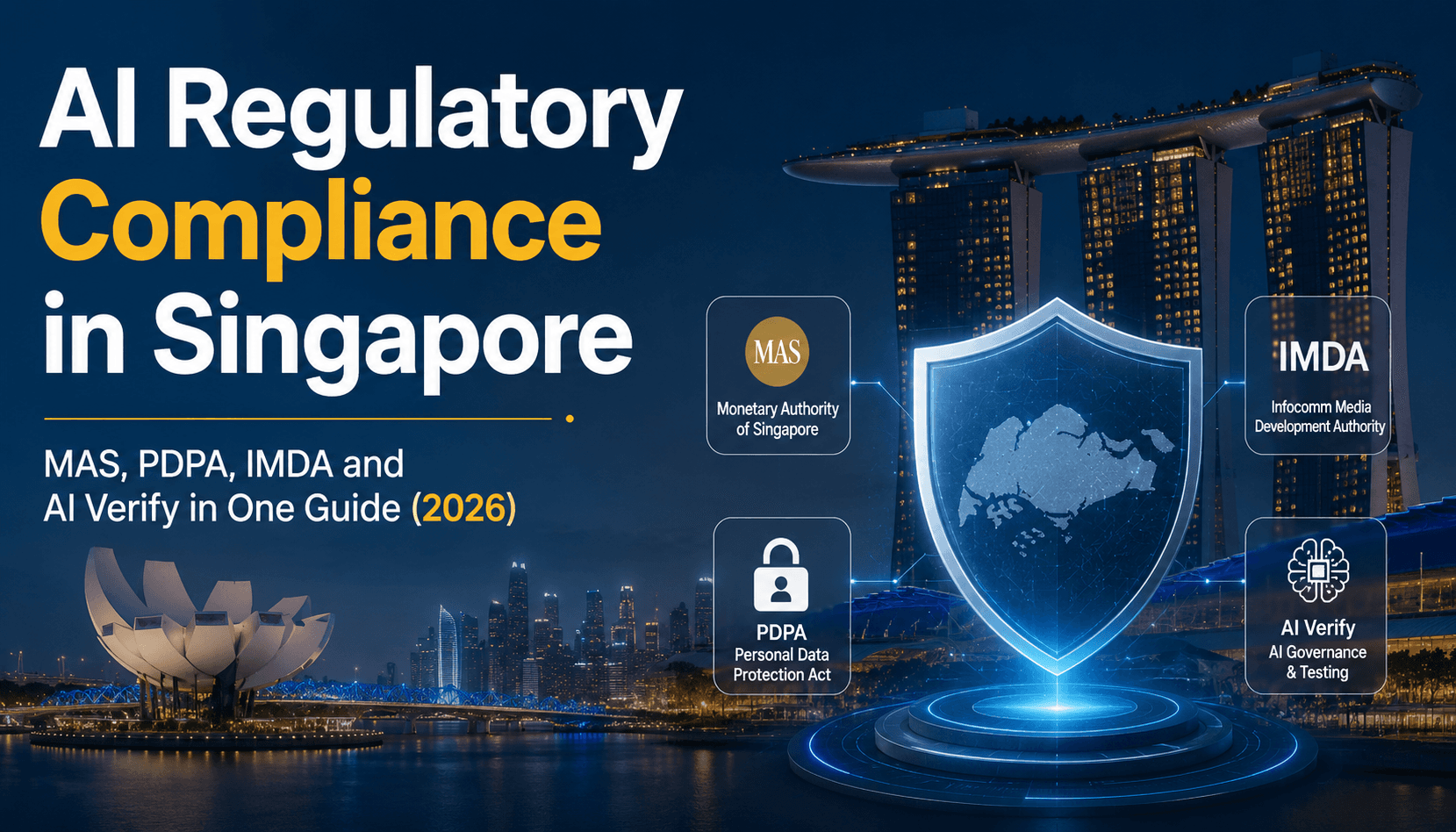
Singapore has more active AI regulatory compliance frameworks per industry than any other APAC jurisdiction in 2026, and most enterprise AI teams are navigating them separately rather than as an integrated compliance architecture. That fragmented approach is creating governance gaps: an institution can satisfy MAS TRM requirements on a credit model while simultaneously failing PDPA obligations on the training data that model was built on. This guide consolidates MAS, PDPA, IMDA, and AI Verify regulatory compliance obligations for Singapore enterprise and BFSI leaders into a single integrated framework, covering what each regime requires, where they overlap, and how to build compliance by design into your AI engineering program from the first sprint.
Regulatory Compliance:
AI regulatory compliance in Singapore in 2026 requires simultaneous adherence to four overlapping frameworks: MAS Technology Risk Management guidelines for model risk governance and audit trail requirements in financial services, PDPA obligations for personal data used in AI training and inference, IMDA's AI Governance Testing Framework for responsible AI deployment across sectors, and the AI Verify toolkit for structured testing and documentation of AI system behaviour against defined principles. Compliance by design means embedding the engineering controls required by all four frameworks at the data pipeline and model serving layer during build, not retrofitting documentation after deployment. For BFSI, MAS model risk governance and FEAT principles add a fifth layer of sector specific obligation on top of the four cross sector frameworks.
The Four AI Regulatory Compliance Frameworks Singapore Enterprises Must Navigate
Framework 1: MAS Technology Risk Management Guidelines
The Monetary Authority of Singapore's Technology Risk Management guidelines establish model risk management obligations for all AI systems deployed by Singapore licensed financial institutions. In 2026, MAS TRM examinations inspect at the individual model level rather than the enterprise policy level. Key MAS guidelines on AI obligations include: complete and current model inventory with risk classification, independent model validation with out of time testing, individual applicant level FEAT explainability for consumer facing AI decisions, data lineage documentation from source to inference, continuous drift monitoring with defined alert thresholds, and Board level AI risk reporting. MAS TRM applies to all Singapore licensed banks, insurers, capital markets firms, and payment service providers. It also extends to third party technology vendors whose AI systems are deployed within these institutions. Review what MAS actually requires for a detailed breakdown of examination level documentation standards.
Framework 2: PDPA Obligations for AI Programs
The Personal Data Protection Act creates PDPA obligations that apply to every AI program using personal data in training, validation, or inference. In 2026, three PDPA obligations are most frequently implicated in AI programs:
AI data usage notification Singapore: organisations must notify individuals whose personal data is used for automated decision making and must be able to explain the basis of any automated decision affecting them on request.
Consent tracking in AI pipelines: consent granted at data collection must be tracked as a metadata attribute through every transformation, storage, and model training step. Consent withdrawal must trigger a traceable deletion or suppression workflow across all downstream systems and models.
Cross border data transfer: personal data used to train AI models cannot be transferred to jurisdictions without adequate data protection unless specific conditions are met. Cloud training environments on AWS, Azure, or GCP require explicit cross border data transfer compliance mapping.
Framework 3: IMDA AI Governance Testing Framework
The Infocomm Media Development Authority's AI Governance Testing Framework provides a structured methodology for testing AI systems against defined governance principles: transparency, fairness, security, and human oversight. It applies across sectors, complementing the sector specific MAS framework for financial services. The IMDA AI governance testing framework requires organisations to document: the purpose and intended use of every AI system, the testing methodology applied before deployment, the test results and any mitigations applied, and the ongoing monitoring approach post deployment.
IMDA's framework does not have the binding enforcement mechanism of MAS TRM or PDPA, but procurement teams at large Singapore government linked companies and statutory boards are increasingly requiring IMDA framework compliance evidence from technology vendors supplying AI systems.
Framework 4: AI Verify Toolkit
AI Verify toolkit is Singapore's national AI testing framework, jointly developed by IMDA and GovTech, providing standardised tests and reporting templates that organisations can use to demonstrate AI system compliance with governance principles. It covers nine governance principles including safety, security, explainability, fairness, data governance, accountability, robustness, and human centricity. AI Verify does not replace MAS TRM or PDPA compliance. It provides a structured testing and documentation methodology that organisations can use to build evidence of governance principle adherence, which is increasingly requested in enterprise AI procurement processes and referenced in MAS examination preparation.
Start Your AI Transformation with a Data-Driven Assessment
Why Integrated Compliance Architecture Matters in 2026
Three developments have made fragmented framework compliance materially more expensive than integrated architecture:
1. Overlapping obligation conflicts are compounding
PDPA consent withdrawal obligations and MAS TRM model performance reporting obligations can conflict: a customer who withdraws consent triggers a data deletion obligation that affects training data used to produce a model performance record that MAS requires to be retained. Resolving these conflicts requires integrated compliance architecture, not parallel framework management by separate teams.
2. AI compliance is moving from voluntary to enforceable
MAS TRM and PDPA are fully enforceable with significant penalty exposure. IMDA's framework is moving from voluntary guidance to procurement prerequisite. AI compliance obligations across all four frameworks are simultaneously becoming more specific and more consequential (Source Required: MAS Technology Risk Management Guidelines).
3. Compliance by design is materially cheaper than retrofit
The cost of embedding all four framework compliance requirements at the engineering layer during AI system build is consistently 3 to 5 times lower than retrofitting compliance controls after deployment under examination or enforcement pressure (Source Required: Deloitte Compliance Cost Research).
The Compliance by Design Framework: Embedding All Four Regimes at the Engineering Layer
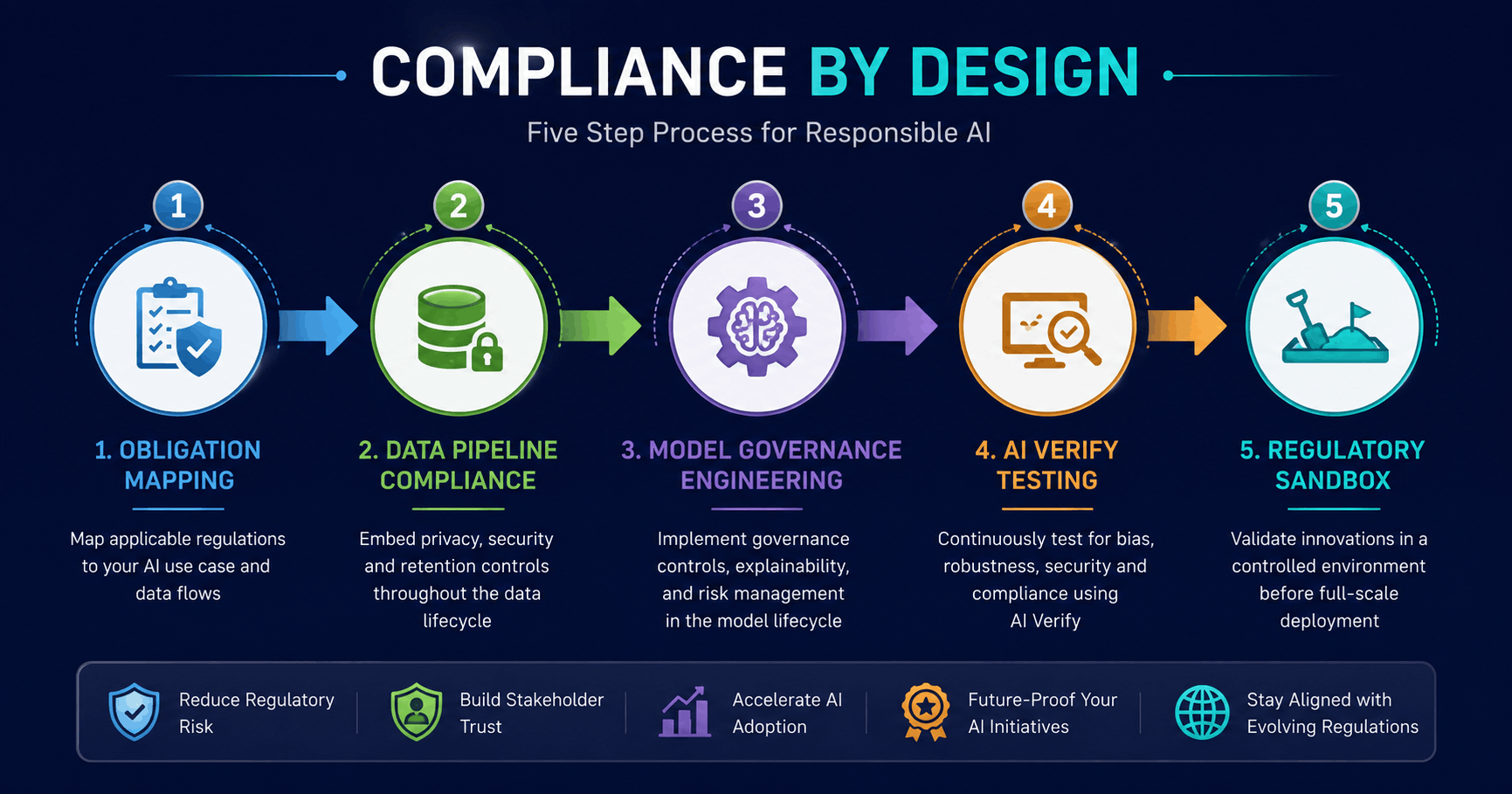
Compliance by design for Singapore AI programs requires mapping each framework's obligations to specific engineering deliverables, then building those deliverables into the AI program from the first sprint rather than treating them as separate compliance workstreams:
Step 1: Obligation Mapping
Produce a four regime obligation map for the specific AI use case: which MAS TRM requirements apply (model risk classification, validation, drift monitoring), which PDPA obligations apply (consent tracking, cross border data transfer, notification), which IMDA testing principles apply (transparency, fairness, safety), and which AI Verify toolkit tests are relevant. This map becomes the governance gate checklist that each engineering layer must satisfy before production deployment is approved.
Step 2: Data Pipeline Compliance Engineering
Build PDPA consent tracking as a metadata attribute in the data pipeline from ingestion through transformation to training dataset construction. Implement cross border data transfer controls at the pipeline layer before any personal data moves to cloud training environments. Document data lineage at the column level to satisfy MAS TRM requirements. Samta.ai's data integration consulting services implement PDPA consent tracking and MAS TRM lineage documentation on Databricks and Snowflake as standard pipeline components, not post build additions. The VEDA AI Decision Analytics Platform connects governed pipeline data to production AI decisions with embedded audit trail generation satisfying both MAS TRM and PDPA audit requirements simultaneously. Review the VEDA platform documentation for the specific compliance infrastructure embedded at the serving layer.
Step 3: Model Governance Engineering
Build model cards, independent validation evidence, and FEAT explainability APIs during model development, not after. Configure drift monitoring with defined thresholds before production deployment. Implement audit trail generation for every inference at the model serving layer. The 6 components of AI governance framework provides the engineering specification for each governance component that MAS TRM and FEAT require at the model layer.
Step 4: AI Verify and IMDA Testing
Apply AI Verify toolkit tests to the production model before deployment. Document test results using AI Verify reporting templates. Include IMDA governance principle mapping in the model card. This step adds 2 to 4 weeks to the pre production validation phase and produces documentation that satisfies both MAS examination preparation and enterprise procurement requirements simultaneously. Samta.ai's AI security and compliance services implement AI Verify testing as part of the pre production governance gate, ensuring that IMDA framework compliance evidence is produced contemporaneously with MAS TRM validation documentation rather than as a separate exercise.
Step 5: Regulatory Sandbox Consideration
For novel AI use cases in financial services where the regulatory treatment is unclear, MAS operates a regulatory sandbox (MAS FinTech Regulatory Sandbox) that allows institutions to test AI capabilities in a live but controlled environment under relaxed regulatory requirements for a defined period. Sandbox entry requires a formal application and evidence of adequate safeguards for participants.
AI Regulatory Compliance Singapore:
Compliance Dimension | MAS TRM | PDPA | IMDA Framework | AI Verify Toolkit |
Applies To | Singapore licensed financial institutions and their AI vendors | All organisations processing Singapore personal data | All sectors, voluntary but increasingly procurement mandatory | All sectors, voluntary testing and documentation |
Primary Obligation | Model risk governance, audit trails, drift monitoring, FEAT explainability | Consent tracking, notification, cross border transfer, deletion workflow | Transparency, fairness, safety, human oversight documentation | Structured testing against 9 governance principles with standardised reporting |
Engineering Deliverable | Model cards, audit trail infrastructure, drift monitoring, lineage documentation | Consent metadata in pipeline, deletion workflow, cross border controls | Testing documentation, governance principle mapping in model card | AI Verify test results, principle mapping, remediation documentation |
Enforcement Mechanism | MAS examination findings, remediation deadlines, licence conditions | PDPC enforcement, financial penalties, public notification | Procurement prerequisites, not regulatory enforcement | Procurement prerequisites, not regulatory enforcement |
Samta.ai Implementation | Embedded in VEDA serving layer and AI security and compliance services | PDPA consent tracking in Databricks and Snowflake pipelines | AI Verify testing as standard pre production gate | AI Verify toolkit tests included in governance gate deliverables |
How Exposed Is Your AI Model to Risk?
Real World Use Cases
Use Case 1: Integrated Compliance Architecture, Singapore Insurance Company (BFSI)
A Singapore licensed insurer was managing MAS TRM compliance through its model risk team, PDPA compliance through its legal team, and IMDA framework compliance through its technology team, with no shared engineering infrastructure. The result: three separate documentation exercises producing overlapping but inconsistent governance records for the same AI underwriting model. Rebuilding the compliance architecture using the compliance by design framework above produced a single governance record per model satisfying all three frameworks simultaneously. Audit trail infrastructure built for MAS TRM also satisfied PDPA notification documentation requirements. FEAT explainability APIs built for MAS also satisfied IMDA transparency principle testing. Total compliance documentation production time reduced by 61% per model deployment cycle. Review AI governance compliance in Singapore for the integrated compliance architecture patterns that produced this outcome.
Use Case 2: PDPA Cross Border Data Transfer Compliance, Regional Technology Company
A regional technology company training AI models on Singapore customer data using AWS infrastructure in the United States had not mapped the cross border data transfer PDPA obligation to its pipeline architecture. During a PDPC audit, the company could not demonstrate that adequate data protection standards applied to the US training environment. Implementing cross border data transfer controls at the Databricks pipeline layer, with contractual safeguards documented for the AWS training environment and consent metadata tracking from collection to model inference, resolved the PDPC finding within 8 weeks. The controls also satisfied IMDA data governance principle requirements, demonstrating the compounding value of compliance by design across multiple frameworks simultaneously. Explore VEDA vs data intelligence platform to understand how platform selection at the data layer affects cross border compliance control implementation cost and complexity. The Onboarding KYC platform demonstrates how PDPA consent tracking and MAS TRM audit trail requirements are embedded simultaneously in a production AI system handling regulated personal data at scale.
Key Risks in Singapore AI Regulatory Compliance
Framework siloing: is the most common and most expensive compliance failure mode. Four separate teams managing four separate compliance workstreams for the same AI model produce inconsistent documentation, duplicated effort, and gaps at the intersection of frameworks where no single team owns the obligation.
PDPA consent metadata lost in ETL transformation: creates systematic non compliance for every model trained on personal data after the transformation point. Consent granted at collection must propagate through every pipeline layer or it cannot be enforced downstream.
MAS TRM documentation reconstructed post deployment: lacks the contemporaneous development evidence that makes it credible in examination. Model cards, validation reports, and audit trail specifications must be produced during development, not after examination request.
AI Verify testing treated as optional: in 2026 is increasingly a procurement risk rather than just a compliance gap. Singapore government linked companies and large enterprises are embedding AI Verify compliance evidence requirements in technology vendor procurement terms.
Cross border data transfer compliance not mapped to cloud training environments: is a PDPA exposure that most organisations discover during audit rather than during program design. Every cloud training environment outside Singapore requires explicit compliance mapping before personal data is uploaded. Review AI governance framework 2026 and AI risk management model for the engineering controls that address each of these failure modes at the architecture layer, and consider the enterprise AI engineering in Singapore capability required to implement them correctly.
Decision Framework: Which Compliance Frameworks Apply to Your AI Program
MAS TRM applies when:
Your organisation is a Singapore licensed bank, insurer, capital markets firm, or payment service provider
Your AI system is deployed within a Singapore licensed financial institution as a third party vendor
Your AI model produces outputs that influence credit decisions, insurance underwriting, investment recommendations, or fraud detection
PDPA applies when:
Your AI training data includes names, NRIC numbers, email addresses, financial records, or any other personal data as defined under the PDPA
Your AI model produces outputs that affect individuals, triggering notification and explanation obligations
Your training infrastructure is located outside Singapore, triggering cross border data transfer obligations
IMDA and AI Verify apply when:
Your organisation is selling AI systems to Singapore government linked companies, statutory boards, or large enterprises with responsible AI procurement requirements
Your AI system has public facing outputs where transparency and fairness documentation strengthens stakeholder trust
Your organisation wants a structured governance documentation baseline that satisfies multiple procurement requirements simultaneously
Discuss Your AI Challenges with Our Specialists

Conclusion
AI regulatory compliance in Singapore is not four separate frameworks requiring four separate compliance programs. It is an integrated engineering discipline where the controls required by MAS TRM, PDPA, IMDA, and AI Verify overlap significantly when designed correctly. Institutions that build compliance by design into their AI programs from the first sprint satisfy all four frameworks with less documentation effort, lower remediation cost, and stronger examination evidence than those that manage frameworks in isolation. The governance architecture you build at the engineering layer determines your compliance posture across every examination cycle that follows. Build it once, build it correctly, and make it part of your standard AI deployment process, not an exception triggered by examination pressure.
About Samta
Samta.ai is a Singapore-headquartered AI Product Engineering & Data Intelligence partner helping enterprises build production-grade AI systems for regulated and data-intensive environments.We help organizations move beyond experimentation by engineering scalable, explainable, and enterprise-ready AI solutions from data foundations and model development to workflow automation and deployment.
Our capabilities combine deep AI expertise, data engineering, and product engineering to deliver measurable business impact across FinTech, BFSI, cybersecurity, regulatory technology, and enterprise operations.
Our enterprise AI products power real-world intelligence systems:
• TATVA : AI-driven data intelligence platform for governed analytics, monitoring, and operational insights
• VEDA : Explainable and audit-ready AI decisioning engine built for compliance-sensitive enterprise workflows
• CORA-Property Management Solutions: : Predictive intelligence platform for real-estate pricing, portfolio optimization, and investment analytics
Backed by ecosystem partnerships with Microsoft, Databricks, Snowflake, and AWS, Samta.ai delivers agile, cost-efficient AI engineering with faster turnaround and enterprise-grade scalability. Trusted by enterprises across FinTech, BFSI, and digital transformation initiatives, Samta.ai embeds AI governance, data privacy, and compliance-by-design principles directly into the AI lifecycle , enabling organizations to scale AI with transparency, accountability, and operational control.
Enterprises leveraging Samta.ai automate 65%+ of repetitive data, analytics, and decision workflows while maintaining governance, explainability, and measurable business outcomes. Samta.ai provides the strategic consulting, AI engineering, and data modernization expertise needed to align enterprise operations with next-generation AI transformation goals.
Frequently Asked Questions
What is AI regulatory compliance in Singapore?
AI regulatory compliance in Singapore requires simultaneous adherence to MAS Technology Risk Management guidelines for financial services AI, PDPA obligations for personal data in AI training and inference, IMDA AI Governance Testing Framework for responsible AI principles documentation, and AI Verify toolkit for structured governance testing. For BFSI, MAS FEAT principles add consumer facing decision explainability obligations. Compliance by design means embedding all four frameworks at the engineering layer during build, not retrofitting documentation after deployment.
What are MAS guidelines on AI for Singapore banks?MAS guidelines on AI are embedded within the Technology Risk Management framework and the FEAT principles. They require: a complete model inventory with risk classification, independent validation with out of time testing, individual applicant level explainability for consumer facing decisions, column level data lineage documentation, continuous drift monitoring with defined alert thresholds, and Board level AI risk reporting. In 2026, MAS examinations inspect individual model documentation, not only enterprise level AI governance policies.
What are Singapore PDPA obligations for AI programs?
PDPA obligations for AI programs include: AI data usage notification Singapore requiring individuals to be informed when their personal data is used for automated decision making; consent tracking through every pipeline transformation layer with deletion workflow capability; cross border data transfer compliance mapping for cloud training environments outside Singapore; and the ability to produce individual decision explanations on request when automated processing affects an individual. These obligations apply regardless of industry sector.
What is the IMDA AI governance testing framework?
The IMDA AI governance testing framework is a structured methodology for testing and documenting AI system behaviour against nine governance principles: safety, security, explainability, fairness, data governance, accountability, robustness, human centricity, and inclusiveness. It provides testing guidelines and documentation templates that organisations use to demonstrate responsible AI deployment. While currently voluntary in enforcement, it is increasingly embedded in Singapore enterprise and government linked company AI procurement requirements.
What is the AI Verify toolkit and is it mandatory?
The AI Verify toolkit is Singapore's national AI testing framework developed by IMDA and GovTech, providing standardised tests, metrics, and report templates for demonstrating AI system compliance with governance principles. It is not currently mandatory under any Singapore regulation, but it is referenced in MAS examination preparation guidance and is increasingly required by Singapore enterprise procurement processes. Organisations that complete AI Verify testing and reporting alongside MAS TRM validation produce compliance documentation that satisfies multiple frameworks simultaneously.