
Summarize this post with AI
A model validated once at launch is already out of date the moment real world data starts drifting away from its training conditions. AI model validation services cover far more than a one time pre deployment check, they need to track degradation continuously once a model is live. This guide covers what production validation actually requires, and how continuous monitoring ties into current MAS and NIST expectations.
AI model validation services:
AI model validation services establish a pre deployment performance baseline, then monitor that baseline continuously in production through drift detection, telemetry and defined degradation thresholds that trigger retraining. The Federal Reserve's SR 26-2, which supersedes the 2011 era SR 11-7 framework, explicitly ties validation rigor to a model's materiality and requires ongoing monitoring, not a one time check. For Singapore financial institutions specifically, MAS's proposed AI Risk Management Guidelines reinforce the same expectation, meaning continuous compliance now depends on telemetry and auditability built into the model's full production lifecycle, not just its initial launch.
What is AI model validation?
AI model validation services cover the independent testing and ongoing monitoring that confirms a model performs as intended, both before deployment and continuously while it runs in production. This differs from a one time model review in scope. Validation at launch establishes a baseline. Continuous compliance means that baseline is checked against real production performance on an ongoing basis, not reassessed only when something visibly breaks.
An ai model validation platform typically combines telemetry collection, drift detection and automated alerting into one system, rather than requiring manual review cycles to catch degradation after it has already affected real decisions. For a deeper breakdown of why this matters operationally, see why AI model monitoring matters and continuous monitoring for AI systems specifically.
Measure Your AI Readiness with a Free Assessment
Why this matters now for Singapore financial institutions
Three developments make continuous monitoring a current compliance requirement, not a best practice suggestion.
The US reference standard explicitly requires ongoing monitoring, not a one time check. The Federal Reserve's SR 26-2, which supersedes the 2011 era SR 11-7 framework, ties validation rigor directly to a model's materiality tier and requires ongoing monitoring as part of its model risk management expectations.
MAS's proposed guidance reinforces the same expectation for Singapore specifically. MAS's proposed AI Risk Management Guidelines, published for consultation 13 November 2025, cover AI lifecycle controls explicitly, meaning financial institutions need monitoring thresholds and defined escalation paths built in, not retrofitted after a model is already live.
Global technical frameworks expect auditability as a continuous property, not a point in time artefact. The NIST AI Risk Management Framework, through its measure and manage functions, expects auditability to persist across a model's full operational lifecycle.
See how this connects to broader model inventory practice in the model your inventory is likely missing, and the practical question of what production readiness actually requires in what does a production ready model look like.
A five step framework for validation and continuous monitoring
Here is the sequence that takes a model from initial validation through sustained production reliability.
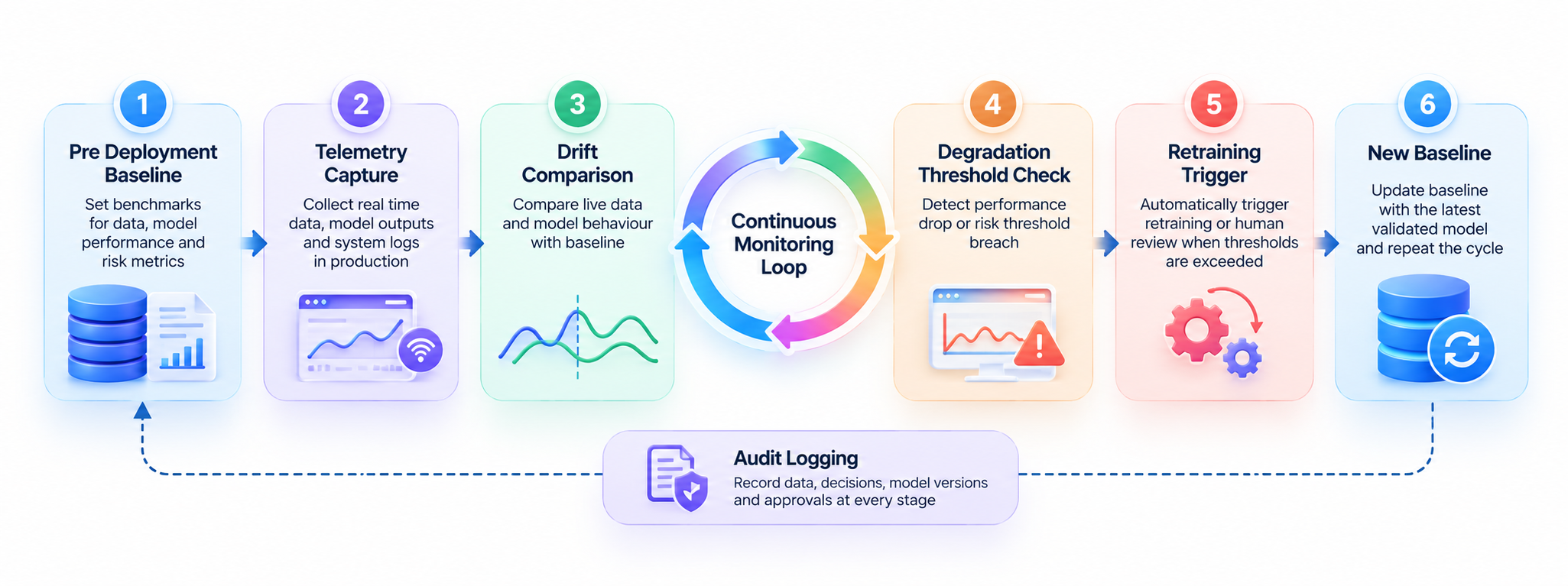
Establish a pre deployment validation baseline. Document model performance against defined metrics before launch, since every later drift comparison depends on having this baseline recorded accurately.
Define degradation thresholds explicitly. Degradation needs a specific, agreed threshold, not a vague sense that performance has gotten worse, so monitoring can trigger action automatically rather than waiting for someone to notice.
Instrument telemetry from day one of production. Telemetry covering input data distribution, prediction confidence and outcome accuracy needs to be captured continuously, not sampled occasionally after a concern is raised. Data integration consulting services support connecting this telemetry data across the systems a model actually touches in production.
Run continuous drift monitoring against the baseline. Model drift monitoring compares live telemetry against the pre deployment baseline on an ongoing schedule, flagging deviation before it meaningfully affects real decisions.
Trigger retraining and document the full audit trail. Retraining needs a defined trigger tied to the degradation threshold, with every validation, drift alert and retraining event logged automatically. AI security and compliance services support building this audit trail directly, and Samta.ai's Veda platform and the Veda AI decision analytics product support this full sequence as the engineering execution layer once the validation framework itself is defined.
Comparing five approaches to AI model validation and monitoring
Approach | Validation frequency | Drift detection method | Audit trail quality | Best fit |
One time pre deployment validation only | Once, at launch | None, no ongoing comparison | Weak, no production record | Not recommended for any production model |
Manual periodic review | Scheduled, often quarterly | Manual comparison, analyst dependent | Moderate, inconsistent format | Low materiality, low risk models |
Rule based drift alerts | Continuous, threshold triggered | Statistical rule checks against fixed thresholds | Moderate, alert logs only | Mid materiality models with stable data patterns |
MLOps integrated continuous monitoring | Continuous, automated | Statistical and pattern based drift detection | Strong, generated automatically | Enterprise models requiring documented compliance |
Integrated decision analytics platform with built in validation | Continuous, automated across connected systems | Pattern based, tied to live business data | Strongest, full lifecycle traceability | BFSI and enterprise running multiple material models |
The last two rows meet both SR 26-2 style and MAS proposed lifecycle control expectations most directly. For a platform level comparison, see Veda versus a general Data Intelligence Platform.
Discover Where Your AI Models Are Most Exposed
Real world use cases
Regulated bank: credit model drift caught before affecting decisions
A bank's credit scoring model performed well at launch, with a documented baseline validation. Eighteen months into production, continuous drift monitoring flagged a gradual shift in applicant data distribution that manual quarterly review would likely have missed for months. The defined degradation threshold triggered a retraining cycle before the drift meaningfully affected approval decisions, with the full event logged automatically for the bank's next MAS style lifecycle control review. See related delivery patterns in Samta.ai's case studies.
General enterprise: manufacturer discovering silent model decay
A manufacturer's demand forecasting model had no ongoing monitoring in place, only an initial validation at launch. Eighteen months later, actual forecast accuracy had degraded significantly without anyone noticing, since reviews happened only when someone manually questioned a forecast. Implementing continuous telemetry and drift monitoring against the original baseline caught a second, smaller degradation event months later, well before it affected a meaningful business decision.
Key risks and failure modes
Treating validation as a one time launch activity. Models degrade as real world data shifts, and a validation performed only at deployment misses this entirely.
No defined degradation threshold. Without a specific, agreed trigger, drift monitoring produces alerts nobody acts on consistently.
Telemetry captured inconsistently or only after a concern arises. Reconstructing historical drift patterns without continuous telemetry data is far harder than capturing it from day one.
Manual review cycles too infrequent for the model's actual materiality. A high materiality model reviewed only quarterly can accumulate significant drift between checks.
No audit trail connecting validation, monitoring and retraining events. Regulators and auditors increasingly expect this full lifecycle record, not just an initial validation report.
Assuming rule based alerts catch everything. Simple threshold rules miss subtler pattern based drift that a more sophisticated monitoring approach would catch.
When to invest in continuous monitoring, and when periodic review is enough
Invest in continuous monitoring now if:
The model informs credit, fraud, or other regulated financial decisions
You are a MAS regulated institution preparing for the AIRG's eventual finalisation
A prior model has already degraded silently without detection
The model operates on data subject to meaningful seasonal or market shifts
Periodic review may be sufficient if:
The model is low materiality, with limited financial or customer impact
The underlying data distribution is genuinely stable over time
The model is used infrequently enough that manual review cycles remain practical
Explore What AI Can Do for Your Business
Conclusion
A model validated once at launch and never checked again is not actually validated, it is a snapshot of performance that may no longer reflect reality. Continuous monitoring is what keeps that validation meaningful over time. Establish the baseline, define degradation thresholds, instrument telemetry, and build the audit trail in from the start. The next step is finding out honestly whether your own models are monitored continuously or just validated once.
About Samta
Samta.ai is a Singapore-headquartered AI Product Engineering & Data Intelligence partner helping enterprises build production-grade AI systems for regulated and data-intensive environments.We help organizations move beyond experimentation by engineering scalable, explainable, and enterprise-ready AI solutions from data foundations and model development to workflow automation and deployment.
Our capabilities combine deep AI expertise, data engineering, and product engineering to deliver measurable business impact across FinTech, BFSI, cybersecurity, regulatory technology, and enterprise operations.
Our enterprise AI products power real-world intelligence systems:
• TATVA : AI-driven data intelligence platform for governed analytics, monitoring, and operational insights
• VEDA : Explainable and audit-ready AI decisioning engine built for compliance-sensitive enterprise workflows
• CORA-Property Management Solutions: : Predictive intelligence platform for real-estate pricing, portfolio optimization, and investment analytics
Backed by ecosystem partnerships with Microsoft, Databricks, Snowflake, and AWS, Samta.ai delivers agile, cost-efficient AI engineering with faster turnaround and enterprise-grade scalability. Trusted by enterprises across FinTech, BFSI, and digital transformation initiatives, Samta.ai embeds AI governance, data privacy, and compliance-by-design principles directly into the AI lifecycle , enabling organizations to scale AI with transparency, accountability, and operational control.
Enterprises leveraging Samta.ai automate 65%+ of repetitive data, analytics, and decision workflows while maintaining governance, explainability, and measurable business outcomes. Samta.ai provides the strategic consulting, AI engineering, and data modernization expertise needed to align enterprise operations with next-generation AI transformation goals.
Frequently asked questions
How do you monitor AI model drift?
Monitor drift by comparing live production telemetry, input data distribution, prediction confidence and outcome accuracy, against the model's original pre deployment validation baseline on a continuous or frequently scheduled basis. A defined degradation threshold should trigger an alert or retraining process automatically, rather than relying on someone noticing a problem after it has already affected real decisions.
What is required for production AI validation?
Production AI validation requires a documented pre deployment baseline, defined degradation thresholds, continuous telemetry capture, ongoing drift monitoring against that baseline, and an automatically generated audit trail connecting validation, monitoring and any retraining events. A one time validation at launch, without ongoing monitoring, does not meet current expectations under frameworks like SR 26-2 or MAS's proposed AI Risk Management Guidelines.
How can financial institutions validate AI models under relevant MAS guidance?
Financial institutions should establish risk based validation rigor tied to a model's materiality, consistent with MAS's proposed AI Risk Management Guidelines covering AI lifecycle controls. This means independent validation separate from the model development team, continuous monitoring with defined thresholds, and audit trail documentation sufficient to demonstrate ongoing compliance, not just a one time pre deployment check.
What is the difference between model validation and continuous monitoring?
Model validation establishes whether a model performs as intended at a specific point in time, typically before deployment. Continuous monitoring tracks that same performance on an ongoing basis once the model is live, comparing current behaviour against the original validation baseline to catch degradation as it emerges rather than after it has caused measurable harm.
How often should an AI model be revalidated?
Revalidation frequency should scale with the model's materiality and how often continuous monitoring flags meaningful drift, rather than following a fixed calendar schedule alone. High materiality models with regulated decision impact typically warrant continuous automated monitoring supplemented by formal revalidation whenever a defined degradation threshold is crossed or at minimum annually.