
Summarize this post with AI
An AI model that cannot explain where its training data came from is not ready for production, regardless of how accurate it looks in testing. AI data governance lineage tools exist to close exactly that gap, tracking metadata, lineage and data quality from source system through to model output, while surfacing bias before it reaches a live decision. This guide covers the framework behind that, not just the tool category.
AI data governance lineage tools:
AI data governance lineage tools track metadata, data lineage and quality metrics from source data through to model training and output, giving organisations a traceable record of what fed a model and why it behaved a certain way. NIST's Special Publication 1270 identifies three categories of AI bias, systemic, statistical and computational, and human, confirming that bias mitigation requires more than checking training data alone. For enterprise and BFSI teams in Singapore and the wider APAC region, lineage tooling is what turns AI governance from a written policy into something a regulator or auditor can actually verify.
What is AI data governance?
Data and AI governance is the set of practices that track, control and document how data moves through an organisation and into AI systems, covering quality, lineage, access and accountability together. This differs from general IT data governance by addressing AI specific requirements directly, documenting training data representativeness, testing for algorithmic bias, and tracing a model's output back to the specific data that shaped it.
An ai data governance framework needs four core elements working together: metadata capture, lineage tracking, quality monitoring and bias testing, not any one of these alone. For a deeper breakdown of the underlying concept, see what is data lineage and why your data isn't ready for AI yet.
Discover a Smarter Approach to Decision-Making
Why this matters now for enterprise and BFSI teams
Three developments make lineage and bias tooling an active priority in 2026.
Bias detection now has a formal, government backed reference framework. NIST's Special Publication 1270, Towards a Standard for Identifying and Managing Bias in Artificial Intelligence, identifies three distinct bias categories, systemic, statistical and computational, and human, explicitly warning organisations against treating bias testing as a narrow, purely technical exercise.
Data quality itself now has a certifiable international standard. ISO 8000-1:2022, the overview document for the ISO 8000 data quality series, establishes formal principles for information and data quality that apply directly to the data feeding AI systems, not just operational reporting.
Global AI risk frameworks explicitly require traceability. The NIST AI Risk Management Framework, through its map function, expects organisations to understand and document where AI inputs come from, which is precisely what lineage tooling is built to provide.
See how this connects to broader AI readiness in the intersection of AI and data engineering, and how it applies regionally in enterprise AI engineering in Singapore.
A five step framework for data quality, lineage and bias mitigation
Here is the sequence that produces a defensible, auditable AI data governance posture.
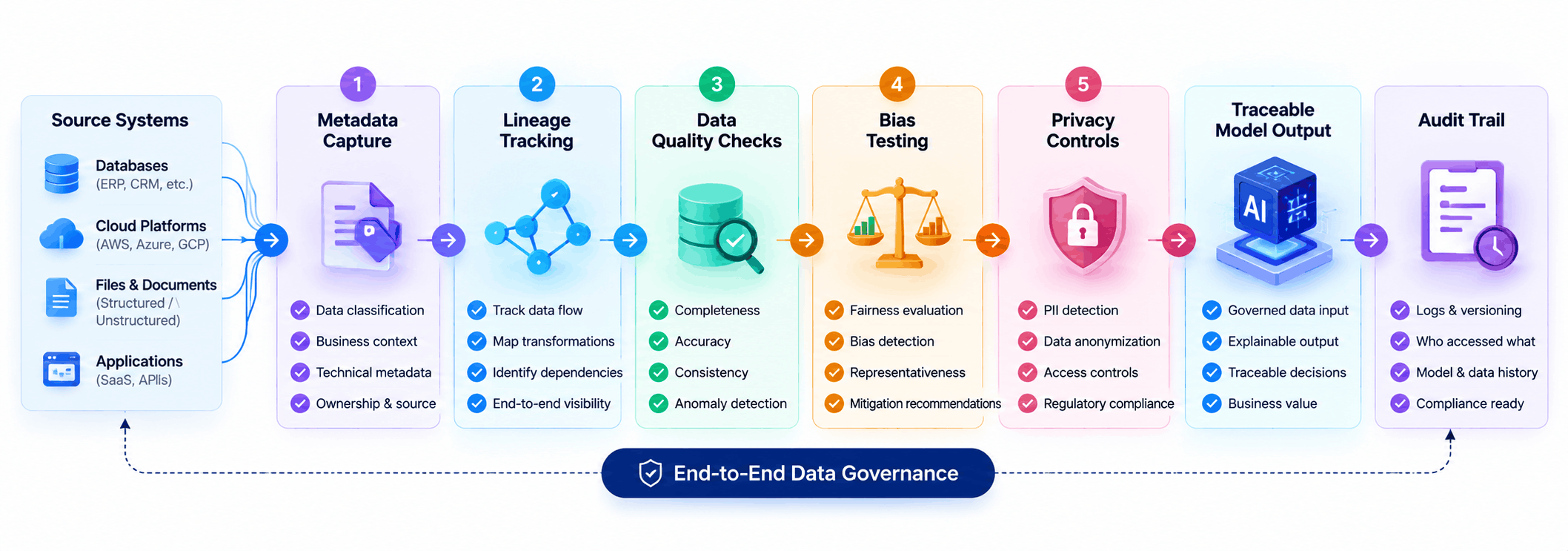
Capture metadata at the point of ingestion. Metadata, who created a dataset, when, from what source, with what transformations applied, needs to be captured as data enters the pipeline, not reconstructed afterward.
Track lineage end to end, from source to model output. Lineage that stops at the data warehouse and does not extend into model training leaves a gap exactly where accountability matters most.
Build data quality checks into the pipeline itself. Data quality for AI should be monitored continuously, not assessed once before a model is trained, since source systems and data patterns shift over time.
Test for representativeness and bias directly, not by inference. Representativeness testing against NIST's three bias categories, systemic, statistical and computational, human, catches issues a general governance policy alone would miss. AI security and compliance services support organisations building this testing capability directly.
Apply privacy controls consistently across the full pipeline. Privacy protections need to travel with the data through every transformation, not just at the point of initial collection. Data integration consulting services and broader data engineering services connect these scattered sources into one governed pipeline. Samta.ai's Veda platform and the Veda AI decision analytics product support this full sequence directly, acting as the engineering execution layer once the governance requirements themselves are defined.
Comparing five approaches to AI data governance tooling
Approach | Lineage tracking | Bias detection support | Metadata management | Best fit |
Manual spreadsheet tracking | Minimal, undocumented, error prone | None, requires separate manual review | Informal, inconsistent | Very small, low stakes projects only |
Basic data catalog | Partial, catalog level only | None | Structured but shallow | Teams starting a governance program |
Dedicated lineage tool, standalone | Strong, detailed column level tracking | None, needs a separate bias tool | Strong, purpose built | Organisations needing lineage specifically for audit |
General data governance platform | Strong, broad coverage | Limited, generic data quality checks | Strong, enterprise wide | Large enterprises with existing data governance programs |
AI native governance platform with integrated bias testing | Strong, extends into model training | Strong, built around NIST style bias categories | Strong, purpose built for AI pipelines | Enterprise and BFSI deploying AI at scale |
The last row is the only approach that extends lineage all the way into model behaviour, not just the data warehouse. For a platform level comparison, see Veda versus a general Data Intelligence Platform.
Identify Gaps, Risks, and Opportunities in Your AI Journey
Real world use cases
Regulated bank: credit model lineage gap surfaced in audit
A bank's credit scoring model performed well in production, but when an internal audit asked for the lineage of specific training data fields, the team could not trace certain inputs back past an intermediate ETL step. The gap had existed since the pipeline was first built. Rebuilding lineage tracking to extend from source system through to the model's training data closed this gap, and the resulting audit trail became a reusable artefact for future reviews. See related delivery patterns in Samta.ai's case studies.
General enterprise: hiring model surfacing systemic bias
An enterprise's AI driven resume screening tool passed a basic statistical bias check on its training data, but a review applying NIST's broader bias framework found a systemic bias issue, the training data itself reflected years of historically skewed hiring patterns the statistical check alone could not catch. Addressing this required retraining with deliberately rebalanced historical data, not just adjusting the model's statistical thresholds, directly illustrating why NIST's framework insists bias testing go beyond narrow model performance checks.
Key risks and failure modes
Treating lineage as a one time documentation exercise. Pipelines change continuously, and lineage tracking that is not maintained as code and systems evolve goes stale within months.
Testing bias only on model outputs, never on training data itself. Statistical fairness checks on outputs alone miss systemic bias embedded in the underlying data.
Capturing metadata inconsistently across different data sources. Partial metadata coverage creates blind spots exactly where a lineage trace is most likely to be needed later.
Applying privacy controls only at initial data collection. Protections that do not travel with data through every transformation leave gaps as data moves and combines across systems.
Confusing a data catalog with a lineage tool. A catalog tells you what data exists. Lineage tells you where it came from and how it changed, a different and more demanding requirement.
Treating ISO 8000 or NIST frameworks as optional reference material. These frameworks increasingly define what a credible, defensible data governance program actually looks like to an external reviewer.
When to invest in dedicated lineage and governance tooling
Invest now if:
You operate AI models that inform regulated or high stakes decisions
A previous audit or review flagged gaps in your ability to trace data lineage
You cannot currently produce bias testing evidence covering systemic, statistical and human categories together
Your data pipeline spans multiple systems with no unified metadata capture
A lighter approach may be enough if:
You run a single, low risk, internal only AI tool with no regulated decision impact
Your data pipeline is simple enough that manual tracking remains genuinely reliable
You are in very early experimentation with no production deployment planned
Know Your AI Model Risk Before You Scale
Conclusion
A governance policy that nobody can trace back to actual data is a document, not a control. Lineage tooling, metadata discipline and bias testing aligned to NIST's framework are what turn that policy into something defensible. Build metadata capture, lineage and bias testing into the pipeline itself, not as an afterthought. The next step is finding out honestly where your own pipeline's traceability actually stands.
About Samta
Samta.ai is a Singapore-headquartered AI Product Engineering & Data Intelligence partner helping enterprises build production-grade AI systems for regulated and data-intensive environments.We help organizations move beyond experimentation by engineering scalable, explainable, and enterprise-ready AI solutions from data foundations and model development to workflow automation and deployment.
Our capabilities combine deep AI expertise, data engineering, and product engineering to deliver measurable business impact across FinTech, BFSI, cybersecurity, regulatory technology, and enterprise operations.
Our enterprise AI products power real-world intelligence systems:
• TATVA : AI-driven data intelligence platform for governed analytics, monitoring, and operational insights
• VEDA : Explainable and audit-ready AI decisioning engine built for compliance-sensitive enterprise workflows
• CORA-Property Management Solutions: : Predictive intelligence platform for real-estate pricing, portfolio optimization, and investment analytics
Backed by ecosystem partnerships with Microsoft, Databricks, Snowflake, and AWS, Samta.ai delivers agile, cost-efficient AI engineering with faster turnaround and enterprise-grade scalability. Trusted by enterprises across FinTech, BFSI, and digital transformation initiatives, Samta.ai embeds AI governance, data privacy, and compliance-by-design principles directly into the AI lifecycle , enabling organizations to scale AI with transparency, accountability, and operational control.
Enterprises leveraging Samta.ai automate 65%+ of repetitive data, analytics, and decision workflows while maintaining governance, explainability, and measurable business outcomes. Samta.ai provides the strategic consulting, AI engineering, and data modernization expertise needed to align enterprise operations with next-generation AI transformation goals.
Frequently asked questions
Why is data lineage critical for AI governance?
Data lineage lets an organisation trace exactly what data fed a model, through what transformations, from what source, which is essential for both debugging unexpected model behaviour and demonstrating compliance during an audit or regulatory review. Without lineage, an organisation cannot credibly answer a regulator's question about why a specific input influenced a specific decision, which increasingly matters as AI governance expectations mature.
How can bias in training data be detected?
Bias detection requires testing across the three categories NIST's Special Publication 1270 identifies, systemic bias embedded in historical data patterns, statistical and computational bias from how data was sampled or processed, and human bias introduced through labelling or design choices. Statistical fairness checks on model outputs alone catch only part of this picture, which is why NIST explicitly recommends a broader, socio-technical approach rather than a narrow model performance exercise.
What data engineering practices support AI readiness and governance in enterprise systems?
Core practices include capturing metadata at the point of data ingestion rather than reconstructing it later, building continuous data quality checks into the pipeline itself, and extending lineage tracking all the way from source systems into model training, not stopping at the data warehouse. Privacy controls also need to travel consistently with data through every transformation, rather than being applied only at initial collection.
What is the difference between a data catalog and a lineage tool?
A data catalog tells you what data exists across your organisation, its location, owner and basic description. A lineage tool tells you where that data originated, what transformations it went through, and how it eventually fed a specific model or report. Many organisations have a catalog without real lineage tracking, which leaves a significant gap for AI governance specifically.
What does representativeness mean in the context of AI training data?
Representativeness refers to whether a training dataset accurately reflects the population or conditions the AI model will actually encounter in production. A dataset that is statistically balanced but drawn from a historically skewed process, for example years of biased hiring decisions, can still produce a systemically biased model even if basic statistical fairness checks pass.